Category: US Air Force


Shooting Stars

48-905 and 48-900 of Air Materiel Command.

This P-80A (44-85031) was, in all probability, the first jet aircraft that many in this crowd had ever seen.

85031 was assigned to the 71st Fighter Squadron when it crashed in 1947.

44-85044 of Wright Field’s Test Division.

44-85123 of the Test Division, Wright Field, won the Thompson Trophy in 1947. This aircraft is now stored at Edwards AFB.

44-85247 was another P-80A assigned to Wright Field’s Test Division.

45-8320 of the 61st Fighter Squadron, Jet Propelled.

44-85460, Wright Field Test Division.

49-477 , Air Proving Ground, Eglin AFB.

44-85257 of the 56th Fighter Group

45-8310 of the 161st Reconnaissance Squadron, Jet Propelled.

45-8568 of the Indiana Air National Guard.

8568 was assigned to the 163rd Fighter Bomber Squadron.

44-85401 was another P-80 belonging to the 61st Fighter Squadron.

TV-1 (3841) of NAS Seattle. This aircraft is now on display at the Seattle Museum of Flight.


RB-66, Spangdahlem Air Base, 1961
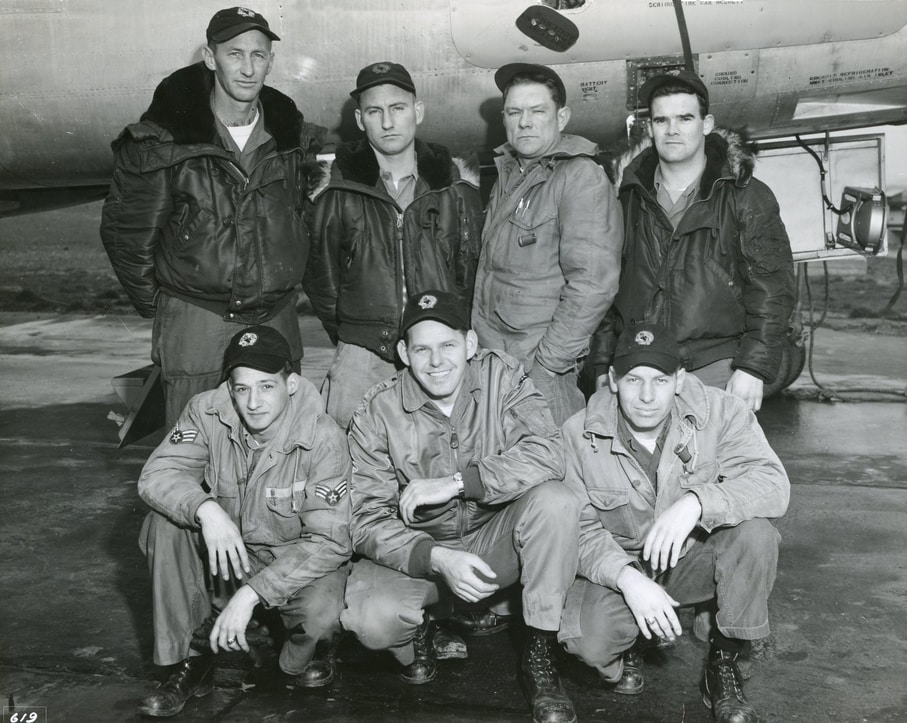 The patches worn on the hats of these maintenance men tells us they are members of the 30th Tactical Reconnaissance Squadron. Looks like a typical rainy day for Germany, and especially for Spangdahlem.
84th Bomb Squadron (Tactical)

With its tail number of 47-084, this B-45A was a natural choice for assignment to Langley AFB’s 47th Bomb Group, 84th Bomb Squadron. The unit later moved to RAF Sculthorpe in the UK.
The B-45 was, of course, America’s first jet bomber, and like many of those early jets it had a checkered career (of the 143 B-45s built, almost one-third of them were destroyed in crashes and other mishaps). There are very few survivors, and 47-084 is not one of them: it ended its days in 1958 at Ramstein Air Base as an instructional airframe for training firemen. In other words, a charred and smashed wreck.
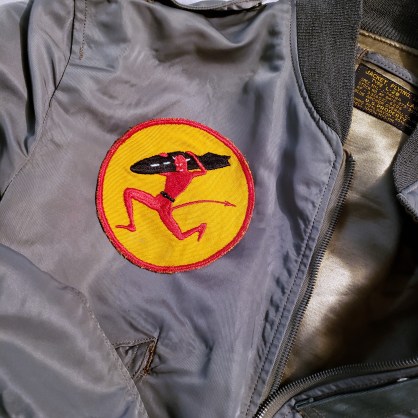
Insignia of the 84th
Junior Birdmen of 1959

T-34

When this photo was taken, T-37 58-1896 was fresh off the assembly line

A photo to show to the folks back home.

T-37A 56-3563 has a long life ahead of it. Today, it is on display in the appropriately named town of Jet, Oklahoma.

The number of pilots who trained in the “Tweet” is beyond counting.

Rainy (and humid) afternoon at Graham Air Base.

By the book, or “Buy the Farm”.

With bulging briefcases, students of the 3300th Pilot Training Group prepare to march.

He is about to be trusted with a multi-million dollar aircraft.
These shots were taken at Graham Air Base, Florida, in the latter half of 1959. The aircraft are the T-34 and, of course, the then new T-37 “Tweet”. Graham was an air force training base, but was operated primarily by civilian contractors and not air force personnel. As such, it did not carry the title “Air Force Base”. By 1959, the era of civilian operated training schools was coming to a close, and Graham Air Base closed the following year.
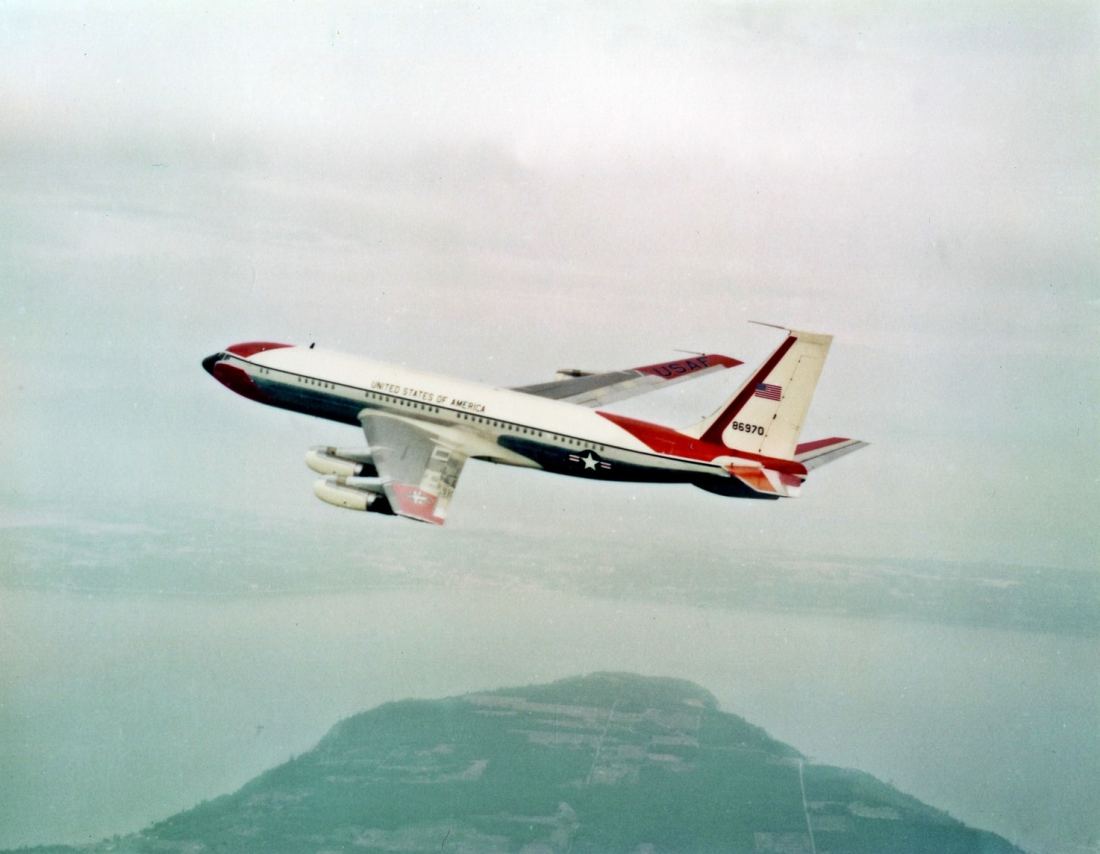
The VC-137A & B

- 58-6960 sports the VC-137’s original markings on an early test flight prior to its delivery to the USAF.


F-102 Delta Daggers!

F-102A on a visit to Paine AFB, WA, circa 1959. Stationed just down the road at McChord AFB, 56-0972 bears the rather simple yet satisfying markings of the 317th Fighter Interceptor Squadron (FIS).

Another 317th FIS bird (56-0958) poses with a predecessor, a replica Spad.
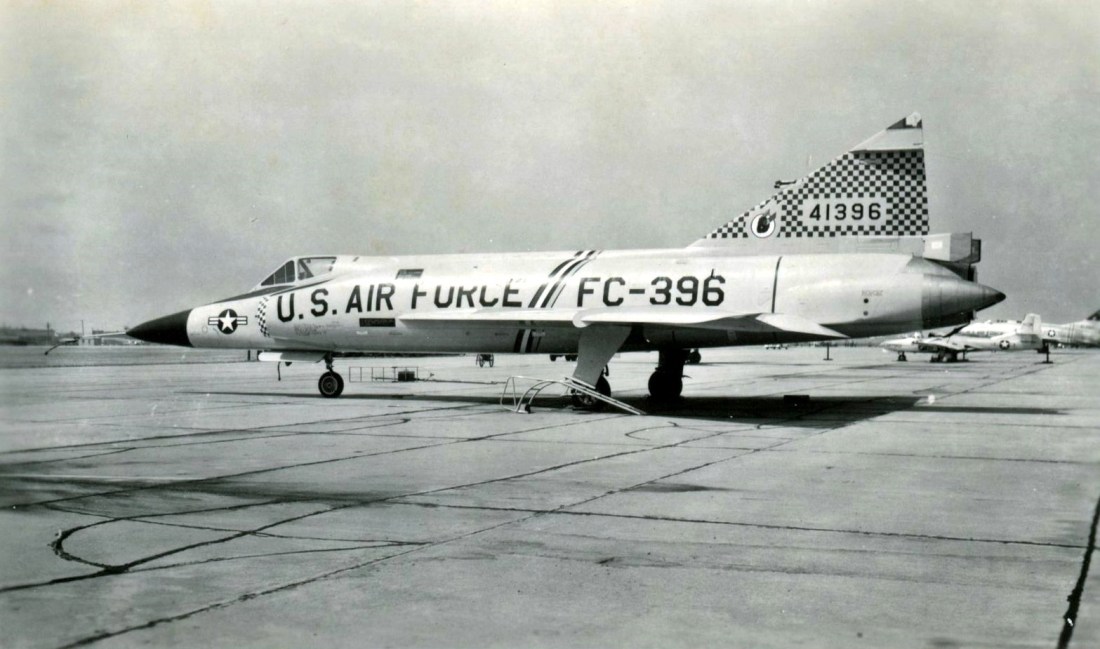
Early F-102A of the 327th FIS.

Another early bird, 53-1817 of the Air Proving Ground Command, 1956. This aircraft was withdrawn from service in 1962 and was then displayed for decades at Lackland AFB, Tx. It is now on exhibit with the Florida Air National Guard, Jacksonville, Fl.

The Washington Air National Guard’s 116th FIS flew the F-102 for only 3 years, 1966-69. This aircraft, 56-0985, is currently on display at McEntire Air National Guard Base, SC.
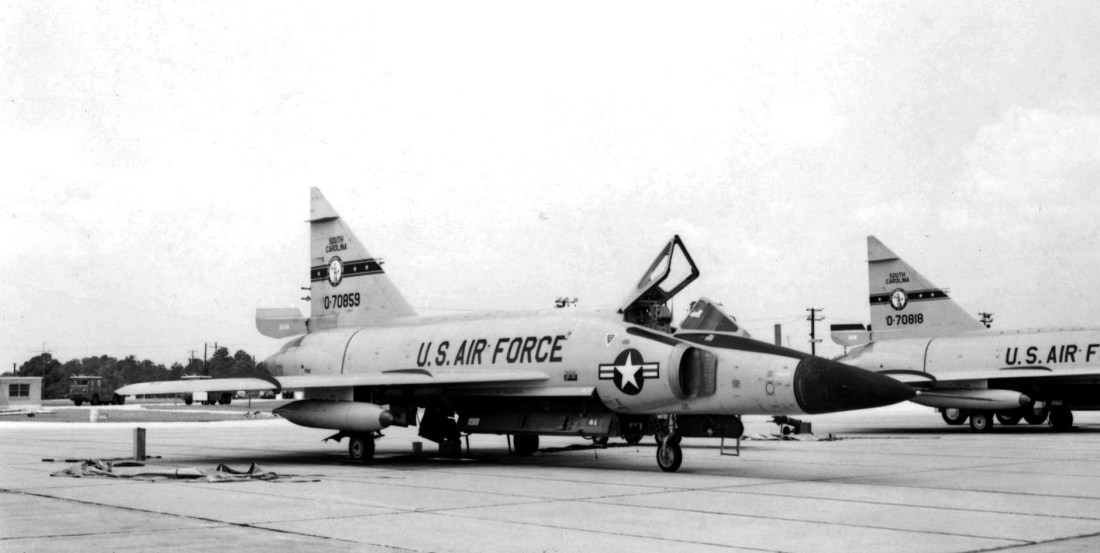
Speaking of South Carolina, here are a brace of 102’s from that state’s 157th FIS, 57-0859 and 57-0818.
F-89D, 58th Fighter Interceptor Squadron

The year is approximately 1955 (The F-89, 53-2568, was written off in 1956), and it’s one of those great airshows of the era. We can only guess at what other aircraft graced the ramp of this unidentified base, so we will have to content ourselves with this gaggle of birds. The 58th FIS Scorpion is from Otis AFB, the B-29 (45-21800), from Langley. A well-known aircraft, this B-29 did the air drops of big name test airplanes way back when (The X-1, Chuck Yeager, being just one of many).
C-123 (54-577) brings up the rear. Scarcely visible behind the F-89 are F-84s of the USAF Thunderbirds. Like I said, one of those great old time airshows.
Boeing bombers that never flew


Here are a few Boeing designs that never made it too far off the drawing board : the Models 436, 461, 474, and 704. Although these models were never flown, you can see a lot of their elements in the B-47’s and B-52’s that were.
Open house, Langley AFB, 1962

Naturally, one sees this photo and says “F-4 Phantom.” However, the picture is early enough to where the sign in front of the aircraft says otherwise: “F-110A Phantom”. That is a bit of a misnomer. While the Air Force did designate their version of the Navy’s F4H Phantom as the F-110, they chose the name “Spectre” instead. Carrying the Navy bureau number of [1]49406, this aircraft’s USAF serial number was 62-12169.
The F-105 alongside (59-1755) is from Seymour Johnson AFB’s 336th Tactical Fighter Squadron. This aircraft was shot down while engaged in a dogfight with a MiG 17 on July 19, 1966. The pilot, Stephen W. Diamond, was seen to eject, but was never found.
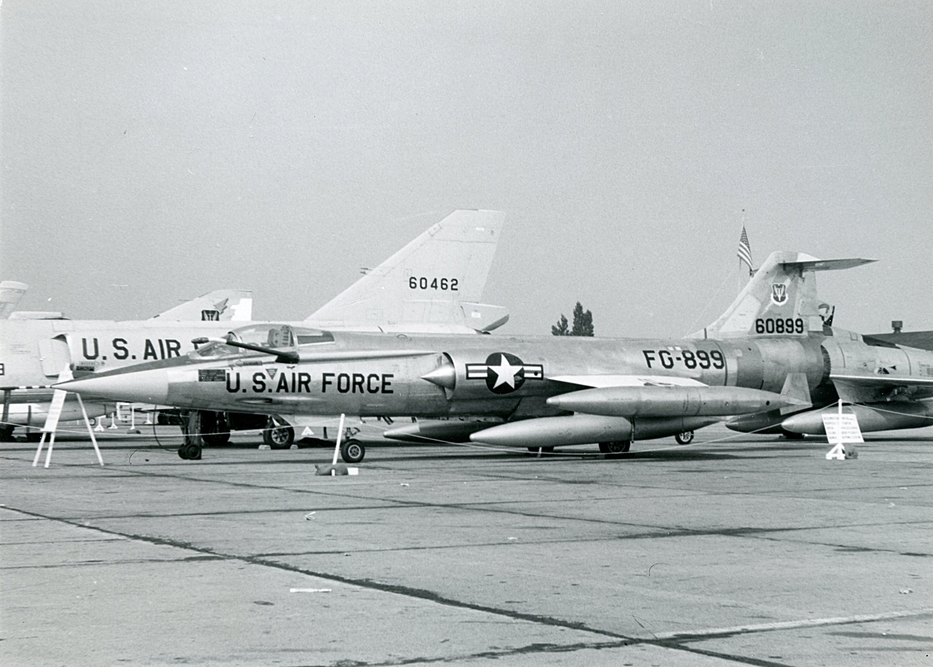
F-104 Starfighter (56-0899) of the 479th TFW, George AFB. The F-106 alongside (56-0462), is from Langley’s 48th FIS. This aircraft suffered engine failure while on a high altitude (70,000 feet) intercept mission on June 6, 1975. The pilot, Captain Stephen Damer, made aviation history when he safely ejected at great altitude and descended some 12 miles or so to the Gulf of Mexico.
Mixed bag of B-29 Superforts

44-87768 was an SB-29 of the 3rd Rescue Squadron. The tail of SB-17G 44-83719 of Hamilton AFB’s 2154th Rescue Squadron is visible to the left.

45-21749 of the 11th Bomb Wing is seen here on the ramp at Carswell AFB. In the background is the XB-36. Note: 21749 was shot down by a MiG 15 on 29 March 1951 while assigned to the 19th Bomb Wing. All were killed including Wing Commander Col. Payne Jennings.

44-61908 and 44-86421 of the 307th Bomb Wing, MacDill AFB. The latter aircraft was lost in a mid-air collision in 1952.

44-8771 of the 509th Bomb Wing was also known as “Priv’ Love Witch”.

Another view of “Love Witch”.

45-21758 of the 97th Bomb Wing

EB-29B 44-84035 of the 4112nd Army Air Forces Base Unit, Olmsted Field, Pa.

44-62295 carries the name “Iron Bird”. Assigned to the 4135th Army Air Forces Base Unit, Hill Field, Utah.

44-62314 of the 43rd Bomb Wing was nicknamed “Gas Gobbler” when it took part in a round the world in 1948.

44-62044 of the 9th Bomb Wing.

Another look at 044, this time parked in St. Louis with the McDonnell Aircraft plant in the background.

44-62234 of the 43rd Bomb Wing. Must be at a Naval Air Station – there are PBM Mariners in the background.

44-86292 is better known as “Enola Gay”.

Another view of Enola Gay.

44-86294 of the 28th Bomb Wing. The unusual device on the belly is the antenna for the AN/APQ-7 radar.

45-21846, an RB-29 of the 72nd Reconnaissance Squadron.

Unknown B-29 of the 468th Bomb Group.

42-65333 of the 4754th Radar Calibration Squadron, Hamilton AFB.

44-86345 of the 2750th Air Base Wing is seen at it’s home of Wright-Patterson AFB.

44-62128 of the 59th Reconnaissance Squadron.

44-87766 served with the 97th Bomb Group until it was transferred to the Navy and renumbered 84031. Note the somewhat removed USAF tail number.
Starfighters of the 83rd FIS, 1959
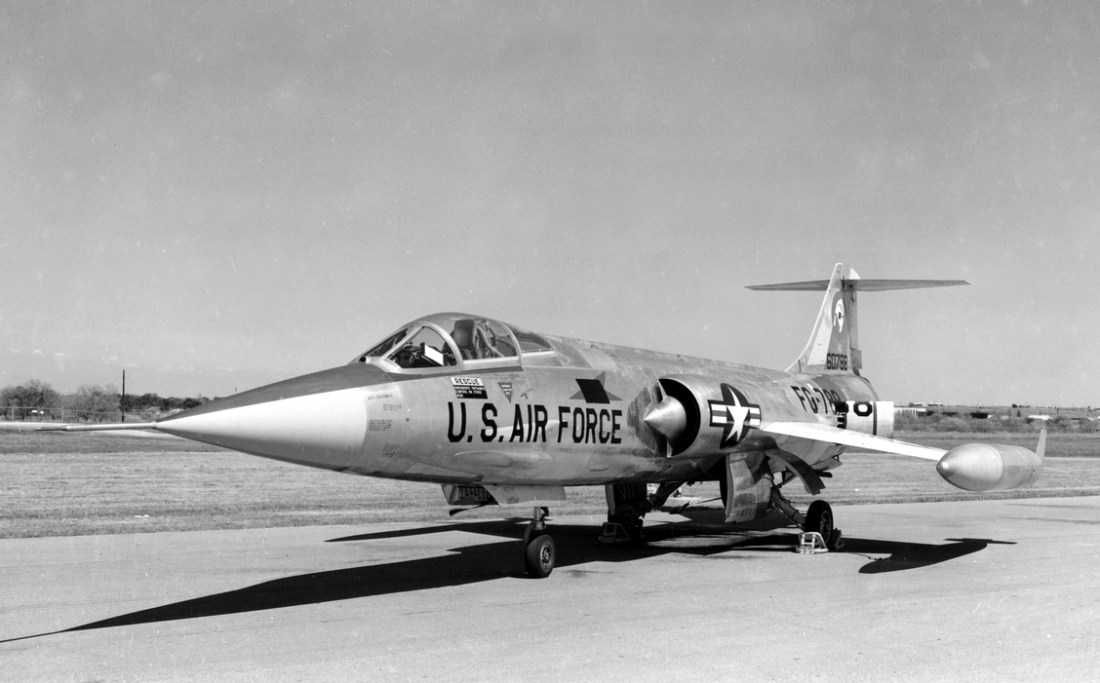

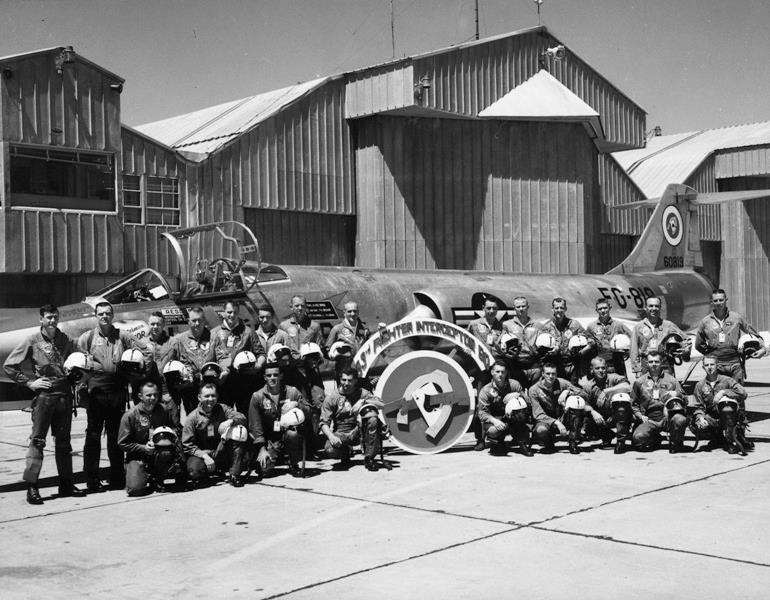
Despite its sleekness and speed, the F-104 was not well-suited to the needs of the USAF. Lacking the range and weaponry of the other interceptors of the day, the 104 never formed the backbone for America’s air defense. Though it served the Air Force for about twenty years, it typically never served in one interceptor squadron for long. Hamilton AFB’s 83rd Fighter Interceptor Squadron as seen here is typical: they flew the F-104 from 1958-60. On average, a USAF Starfighter squadron operated the type for only four years. This is in sharp contrast to the service the F-104 provided to air forces abroad. This was especially so in the skies of Europe where it was flown by a host of nations and was a familiar sight for decades.
Aircraft seen here are 56-0788 and 56-0819. In keeping with the Starfighter serving abroad theme, 788 was soon transferred to the Republic of China Air Force.
Back when orange flight suits were the thing…


Here are 1960s flight suits from two of the USAF’s F-106 units: The 95th and 5th Fighter Interceptor Squadrons. Based, respectively, at Dover and Minot AFB, these squadrons were both long-time operators of the “Six”.
Oddball Aircraft

The Westland-Hill Pterodactyl was one of a number of tailless aircraft designed by that firm in the 1920s. A revolutionary idea, but I have to say that in looking at this photo one would be excused for thinking it was the result of some dire mishap.

Due to its flying characteristics (to say nothing of its appearance), the Vickers Vulcan carried the nickname “Flying Pig”.

The YC-123 was fitted with skis, wing floats, and a host of other devices with the idea of having an aircraft that could fly (and land) just about anywhere.

VB-17G (44-83259) was a VIP transport for General Carl Spaatz during the time he was the Air Force’s first Chief of Staff. The aircraft was nicknamed “Boops” after his daughter.

Boeing’s XAT-15 was a promising trainer but was elbowed aside in favor of other designs. Somewhat of a throwback in construction (it used a lot of wood), the aircraft is seen here at Boeing’s Wichita plant (note the Stearmans in the background).

The XB-24N (44-48753) was another one-off Liberator, but not too bad an idea. It did illustrate that a B-24 was doable with only a single horizontal stabilizer.

The Vultee Vulture in its original configuration. With the snug-fitting engine cowl and nacelle, one could easily mistake the aircraft for having a liquid-cooled engine. It did not, but the engine didn’t like it so Vultee eventually opted for a more conventional open cowl.

The XB-24J (42-73130) was a one of a kind aircraft that incorporated the nose of a B-17G. (Translation: Okay, maybe that wasn’t such a hot idea after all.) Due to the numerous “Frankenstein” versions of highly modified B-24s, there must have been something about its design that caused engineers to have fantasies about modifying the aircraft into something it was never intended to be.
Hahn Air Base, 1956

T-33 16817 of the 50th Fighter Bomber Wing and F-86H 53-1429 of the 417th Fighter Bomber Squadron. The photo was taken April 28, 1956. Both aircraft would crash in the coming weeks.

417th FBS pilot explains the workings of the F-86 (53-1472) to an interested German civilian.

T-33A 51-6834 attracts a crowd of locals at the Hahn open house. When I was stationed in Germany, the annual “Flugtag” brought in huge crowds. Some came for the aircraft, others for the ice cream.

Air Policeman makes sure no one walks out the gate with a brand-new F-86.

T-33A 51-4502 assigned to Hahn’s 69th Tactical Missile Squadron. This aircraft was later sold to the Singapore Air Force and is now on display in that country.

T-33A hurries past the Hahn tower.

F-86H 53-1430 of the 417th FBS. This aircraft was the personal mount of Chuck Yeager when he commanded the 417th during this time.

417th FBS boss Chuck Yeager and pals with Yeager’s bird, 1430.
Early KC-97A at Boeing Field

Born a cargo aircraft, C-97A 49-2591 was soon converted to a tanker configuration as seen here. Her air refueling days were short-lived as she was then reconfigured to once again become a trash hauler. Not the very obvious rear cargo doors where the boom operator’s pod has been attached.
124th Fighter Squadron, Iowa Air National Guard, 1951

“To minimize risk, only the fewest number of men required should refuel an aircraft” ~ Air Force Technical Order on the Refueling of Aircraft

Men of the 124th Fighter Squadron

Air Policemen defy anyone to touch the squadron’s C-47.

Iowa Air Guard F-51s and a lone AT-6

Working hard for the Guard.
The year 1951 was busy for the Iowa Air National Guard at Des Moines Airport. At the beginning of that year the boys had been flying F-84 Thunderjets, but with the Korean War now in full-swing those F-84s went to active duty units while Iowa reverted to the F-51. Having flown them from 1946-1949, the 124th and the Mustang were old friends. This state of affairs continued until the war ended thus making jets available once again.
The original “Skyblazers”
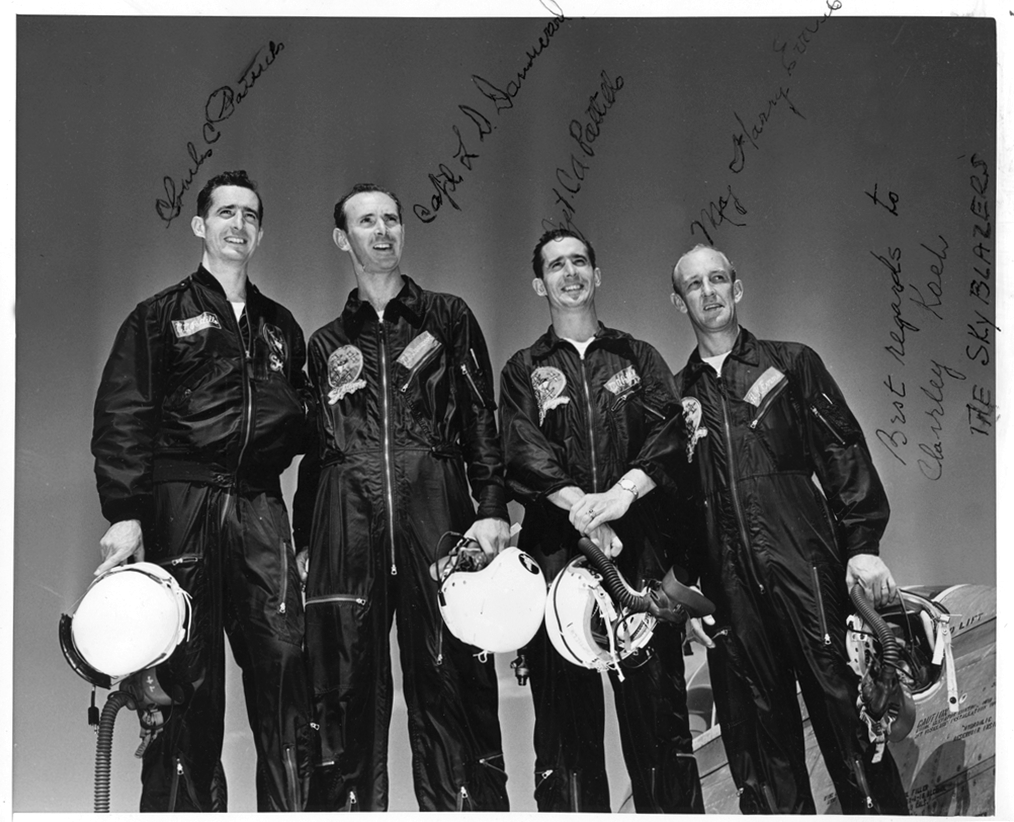
From 1949-1962, the Skyblazers of US Air Forces Europe (USAFE) thrilled European audiences with feats of aerial precision and showmanship. Here they are in the early days atop one of their F-84 Thunderjets: team founder Major Harry Evans, pilots Lawrence “Dagwood” Damewood, and twin brothers Charles “Bill” & Cuthbert “Buck” Pattillo.
Young pups: K/C-135’s in the early 60’s.

KC-135A 59-1504 “City of Tacoma” on the ramp at McChord AFB in 1961.

Another shot of “City of Tacoma”. Now 60 years old and still flying.

1504 flew with the 22nd Air Refueling Squadron, 1960-1962 – McChord’s brief time as host to tankers.

60-0357 started life as a C-135A but was quickly converted to a tanker configuration. Still flying today.

C-135A 60-0369 never underwent the tanker conversion. This, no doubt, is one reason it had a comparative short life: eventually used as a ground trainer, then scrapped.

C-135B 61-2264 was also not “tankerized” but was converted into an RC-135, “Cobra Ball”, assigned to Eielson AFB, AK.

2664 role as a “Cobra Ball” spy plane ended tragically on March 15, 1981, when it crashed on Shemya Island killing 6 of the crew. Stationed in Alaska at the time, I remember the tragic incident well.

61-2664, 665, 666, and 667 on the Renton ramp in the early 60’s. All were converted to some form of intelligence gathering configuration.

61-0278 was the 500th KC-135. Delivered in 1962, she was dubbed “Miss Ak-Sar-Ben” – “Nebraska” spelled (for whatever reason) backwards. She was converted to an EC-135 and ended her life in the bone yard.
A soggy day for an airshow…

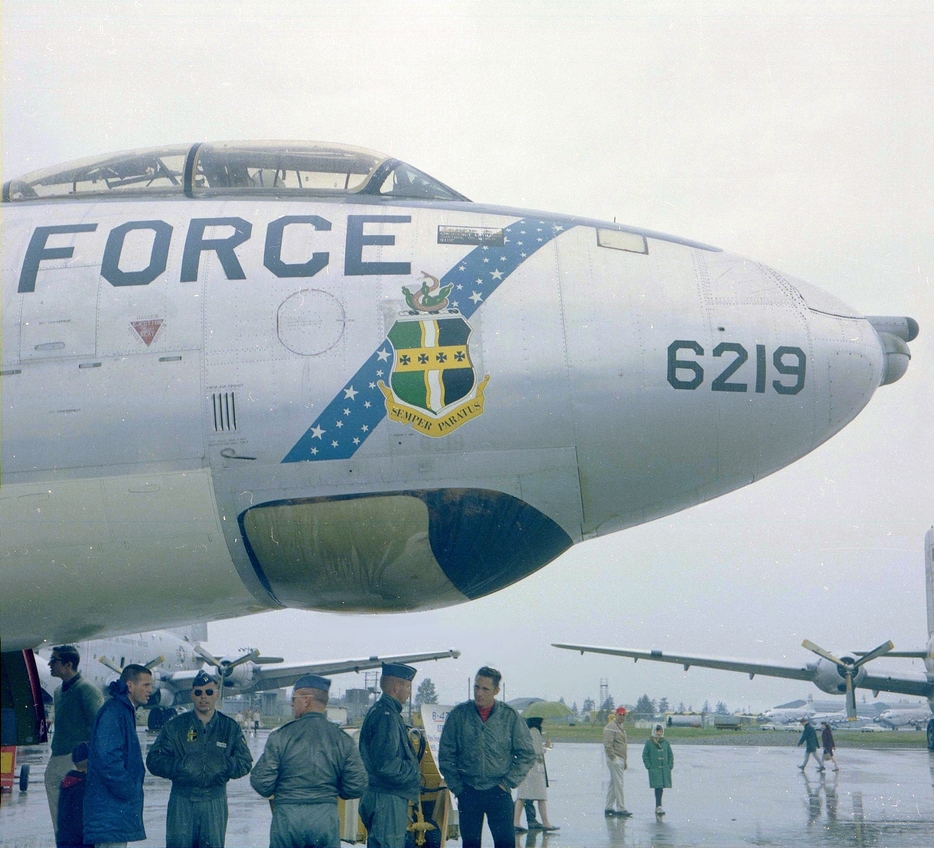
It is a rainy day at McChord AFB, but such weather never deters the die-hard aircraft fans. B-47E 53-6219 – as with all Stratojets – was nearing the end of its days when this photo was taken in 1963, but it could still draw admirers. (Made a good umbrella too) This 9th Strategic Aerospace Wing aircraft was visiting from Mountain Home AFB, a place where rain is less a concern than dust and tumbleweeds.
When this photo was taken, McChord AFB was home to a rather large fleet of rather large aircraft: The C-124 Globemasters, many of which are seen in the background.
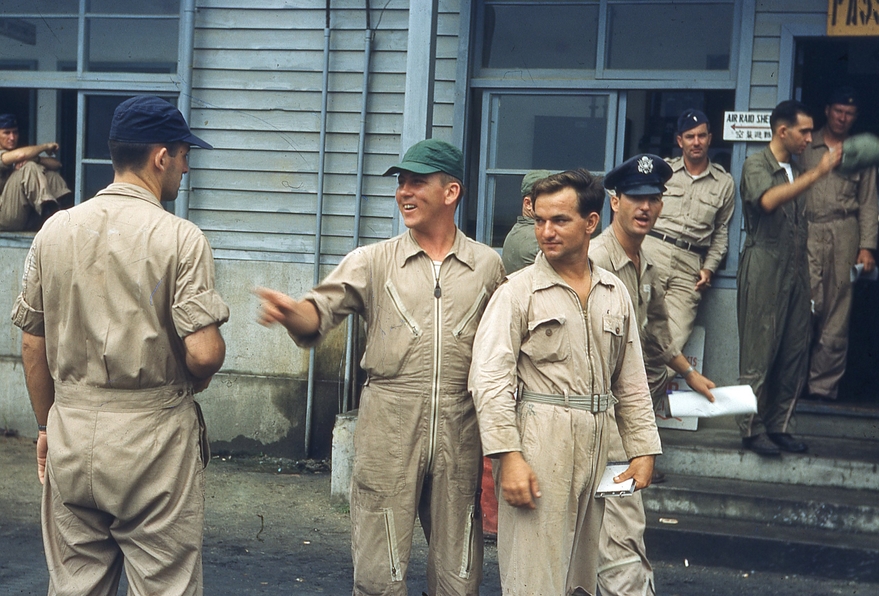
Pilots and F-80’s of the 26th Fighter Interceptor Squadron

With his .50 caliber gun muzzles showing evidence of wear & tear, the pilot of this 26th FIS F-80 (49-0649) drives past the tower at Naha Air Base, Japan.
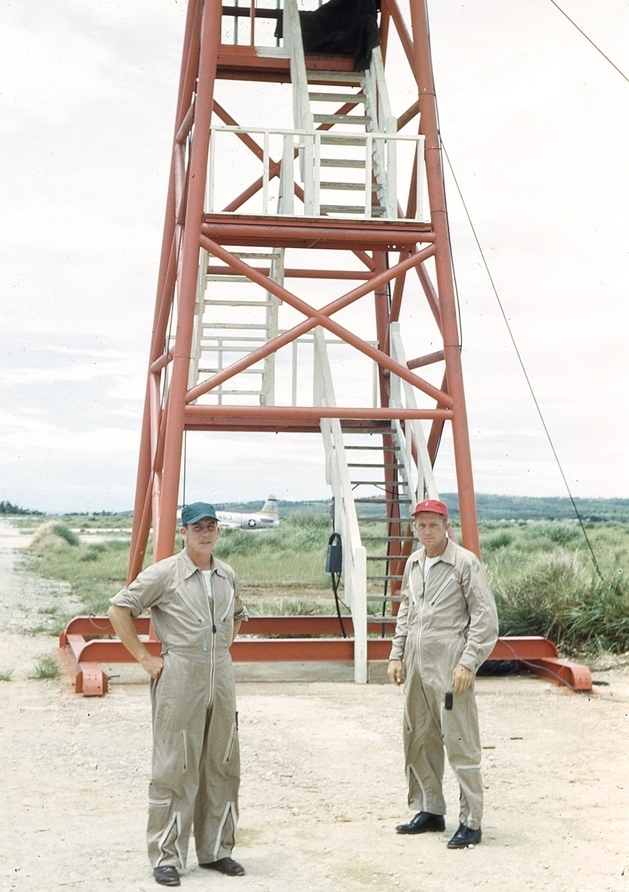
49- 0453 sits quietly beyond the tower. Note the portability of said tower.


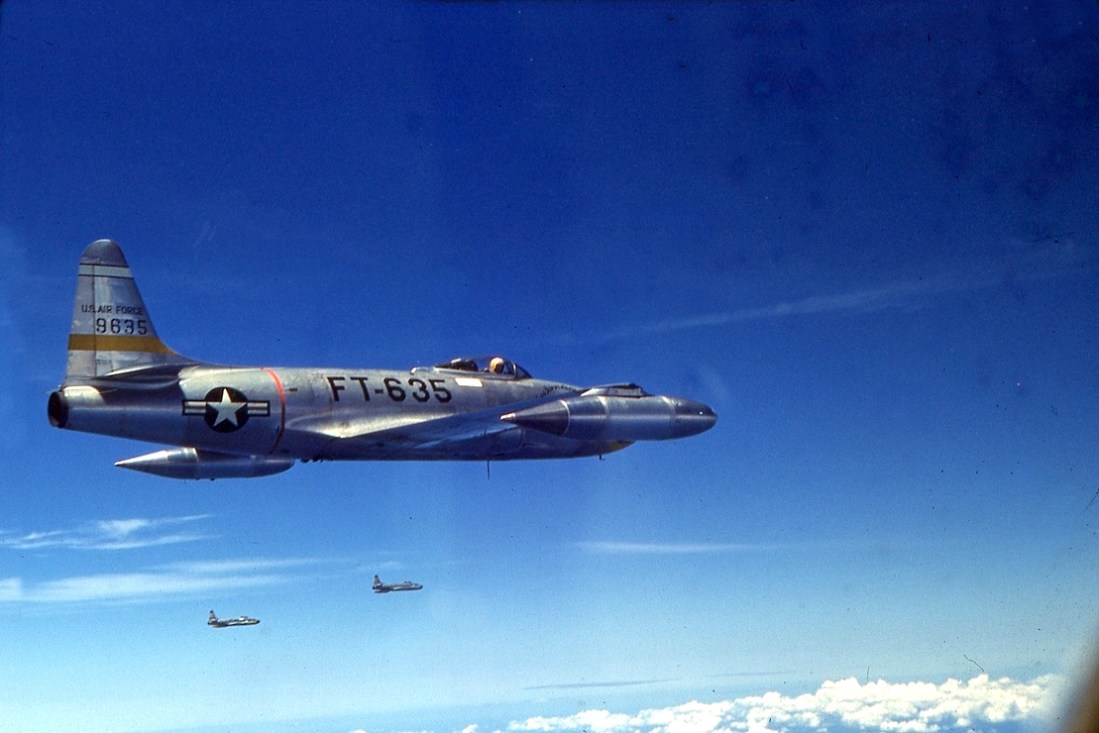
Nice day for flying as 49-0635 & co. cruise the Japanese skies in the early 1950’s.
Here’s five feet of the 18th Fighter Interceptor Squadron


Five feet is the length of this photo, and given that I had to scan it in segments then stitch it all together, I would not have minded had the 18th FIS done its job with fewer men. That being said, it is a great shot of the entire squadron at Ladd AFB, Alaska, on July 18 1955, Major John “Buck” Rogers commanding. The following summer they moved to the somewhat less frigid Wurtsmith AFB in Michigan. F-89D Scorpions were the weapons of choice for the 18th in Alaska. One can be identified: 52-1839.
Sabre Dog in New Mexico
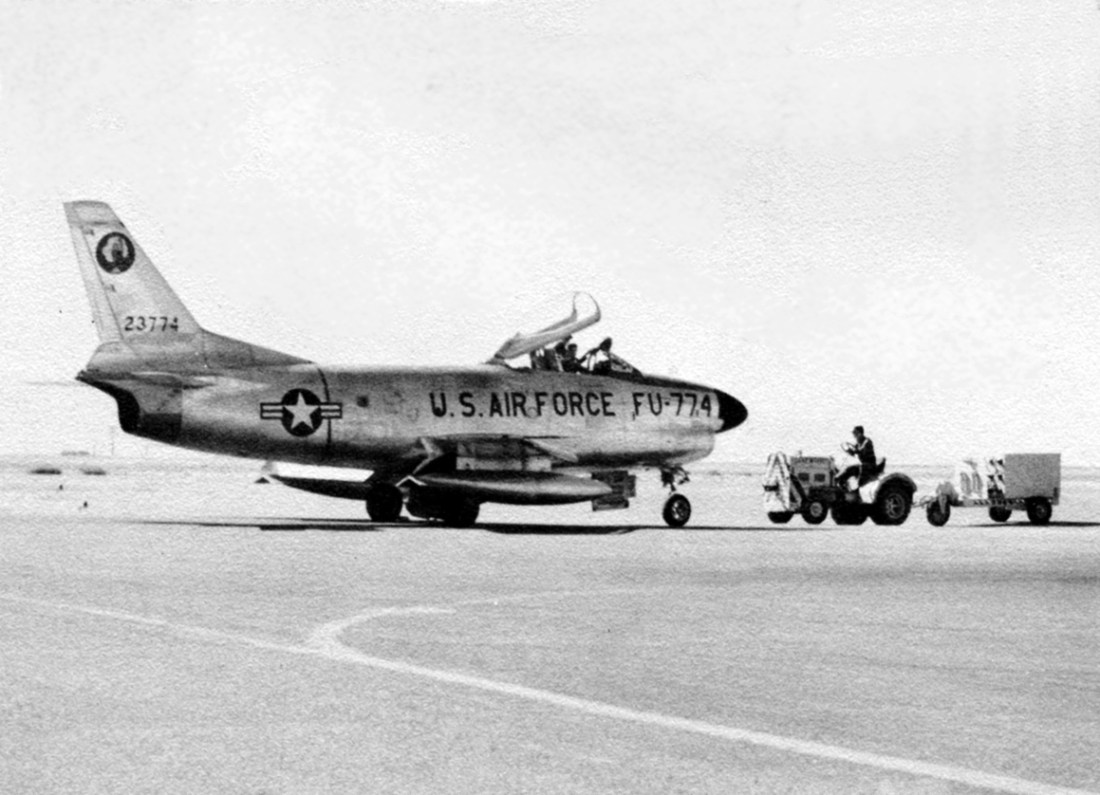
F-86D (52-3774) of the 93rd Fighter Interceptor Squadron in front of the alert barn at Kirtland AFB, New Mexico around about 1957. What was there to make it worth a man’s while to go up and intercept things you ask? Answer: New Mexico was home to all things atomic bomb.
Hot “Dog”