727 Early Birds

While perusing a shoebox of old negatives & positives, these 727 pics were discovered. All were taken in 1963 or (early) 1964.

Factory-Fresh 707s

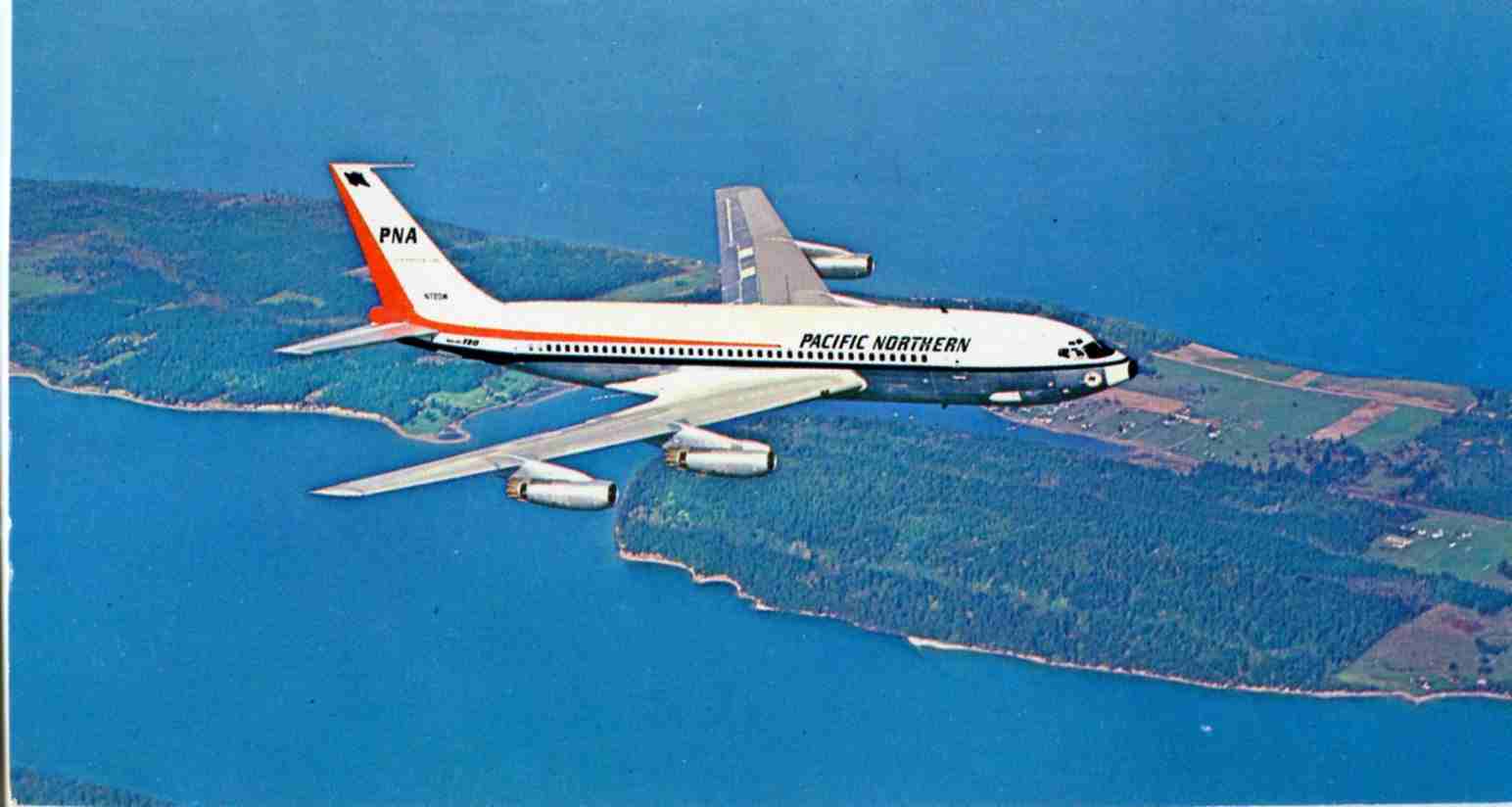
Here is a batch of photos (of varying quality) from the early/mid 1960s that captured a mixed bag of 707s as they began what was for many, a long life of service with various airlines.

“Mystery Airfield” is actually…

Myst

Had a couple of good guesses at our mystery airfield, but…

It is Bellingham Airport, in Washington State.

And said airport has grown a bit over the years.

A couple of classics are parked on the ramp: A P-51 Mustang on the right, and, of course, a DC-3 on the left. The latter wears the livery of West Coast Airlines (who called their DC-3s the ScenicLiner).

West Coast Airlines is kind of/sort of still around today. It merged with Pacific Airlines +Bonanza Airlines to make Air West which became Hughes Airwest which was then taken over by Republic Airlines which was acquired by Northwest which became part of Delta. It’s that simple.

TWA Back in the Day

One of the many versions of the 707, namely the 707-131, is seen here. Once a familiar sight at airports around the globe, the 707-131 is, alas, no more. However, even in retirement it still had an important job to do: After faithfully serving TWA (and other airlines), the -131 became a useful source of parts for the USAF in the 1980s. Namely, the Air Force wanted the -131’s Pratt & Whitney TF-33 engines for the purpose of upgrading the KC-135A. Once re-engined, the “A” model became the KC-135E. Thus the retired 707-131s were given a lease on life to serve as suppliers of engines and parts.

For many years, the retired 707s were a familiar sight at the Davis-Monthan AFB boneyard as they were slowly picked to pieces for useful KC-135E parts (The E-model was retired in 2009). No doubt, more than a few boneyard visitors in the early 21st Century wondered why the USAF was storing a fleet of somewhat dilapidated civilian 707s.

Yoon-kers

Back in the 1920s, Junkers was way ahead of the competition when it came to modern design and function (looking at the company’s F13, it’s hard to believe it is over a century old). In a time when aircraft manufacturers were still quite content to swaddle their products in heaps of fabric, Junkers was already wrapping their birds in metal. It is little wonder then that Junkers, in the 1920s and 30s, was a force to be reckoned with. 

1969: Boeing Gets a B-47

As the B-47 fleet was retired in the mid-1960s, it occurred to Boeing that despite having built over 2,000 Stratojets for everyone else, they didn’t have one to call their own. This issue was happily resolved when the USAF handed its last operational B-47 (by then converted to a WB-47) to Boeing in 1969. That bird, 51-7066, is, of course, still at Boeing Field today, where it is proudly parked in front of the Museum of Flight.

Vanished: The “Hawaii Clipper”

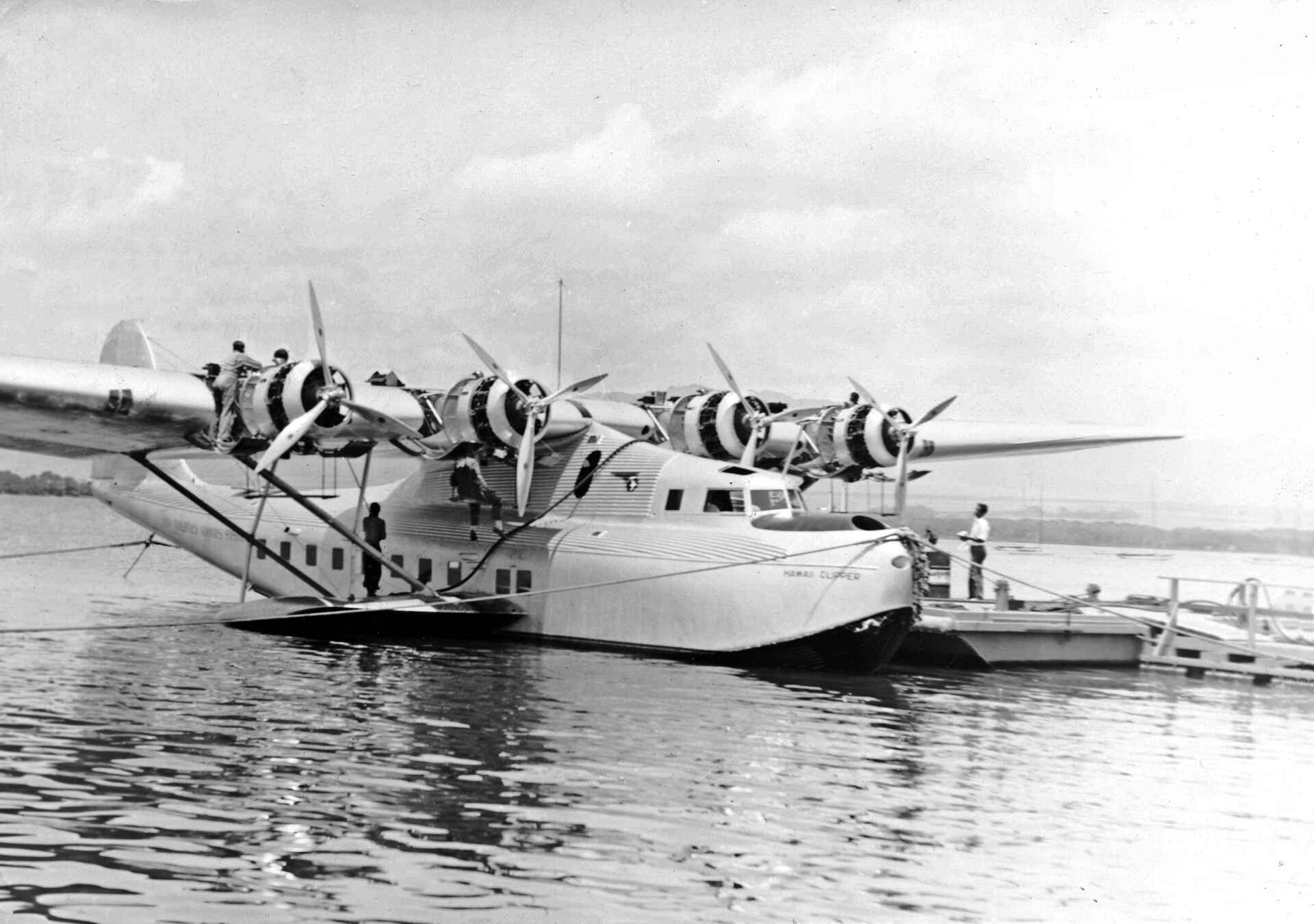
Martin M-130 Hawaii Clipper

Seen at Pearl Harbor’s Fleet Air Base in 1936-37, this Martin M-130 – better known as Pan Am’s “Hawaii Clipper” – is prepped for its next long hop over the Pacific. Sadly, in 1938, somewhere between Guam and Manila, this aircraft disappeared with all its crew and passengers, never to be seen again.

Conspiracy theories sprang up, ones that continue to this day. Chief among these rumors is that the plane was sabotaged by Japanese secret agents to prevent it from delivering millions of dollars for military aid to China. A more plausible scenario (but less spy thriller) is one where the plane flew into unavoidable severe weather and was destroyed (the last radio contact was interrupted due to weather-related static).

Japanese spies aside, the cause that led to the disappearance of the Hawaii Clipper will probably always remain a mystery.

From the “Looks are Deceiving” Dept.

The Loening Model 23/S-1 of the early 1920s is a testament that one cannot judge an aircraft solely by its appearance. Yes, the Model 23 looked somewhat ungainly in its design. Yes, it looked far more hydrodynamic than aerodynamic (This outward form would explain the origins of the Model 23’s official name:  “The Flying Yacht”). 

But, as they say in the Looks are Deceiving Dept…

In actuality, the awkward-appearing “Flying Yacht”, was an amazingly efficient airplane. First taking to the sky in 1921, Loening’s bird won multiple awards for its design – including the Collier Trophy. It also set world records for speed, distance, and altitude. To top it off, the Model 23 was one of the first monoplane-configured seaplanes to go into production. 

Loening’s “Flying Yacht” was quickly eclipsed by the rapid advances in 1920s aviation, but for a brief shining moment, it was unquestionably among the top seaplanes in the world. 

The 707 Mini

It is easy to look at photos of a 707 and say to oneself, “Look, it is a 707”. However, any aficionado of Boeing’s first jet airliner knows there are more than a dozen 707 variants, and one of those derivatives was the 707-138B.  Shorter by ten feet compared to the standard 707-120, the 138B was used exclusively by Qantas Empire Airways, which favored the abbreviated version due to its increased range.

The aircraft seen here, N-93134, is the first 138B built and was initially used for testing by Boeing. That project completed, in July of 1961, the bird was off to Australia as VH-EBH, “City of Darwin”. 

One of the interesting details in these photos is that even though Boeing was using the plane for testing, it already bears most of the red and white livery of its ultimate customer: Qantas. 

Boeing 314 #1

img057

These photographs feature the first Model 314 produced by Boeing (later registered as NX18601). As with most prototypes, the first 314 model encountered some challenges during its development. One of the primary issues was related to lateral control. Although the aircraft was built with a standard single centerline vertical fin, early test flights revealed a need for more lateral control. To address this problem, a growing number of vertical stabilizers were installed on the aircraft. Initially, the solo center tail was removed and replaced with a pair of endplates. However, this dual arrangement proved insufficient, and a centerline fin was once again added to the aircraft, which proved to be effective in providing the necessary lateral stability. once again the 314 was provided with a centerline fin (Hey, good thing they didn’t throw that item away when they did the initial redesign of the tail)

Post-War Life for Catalinas