


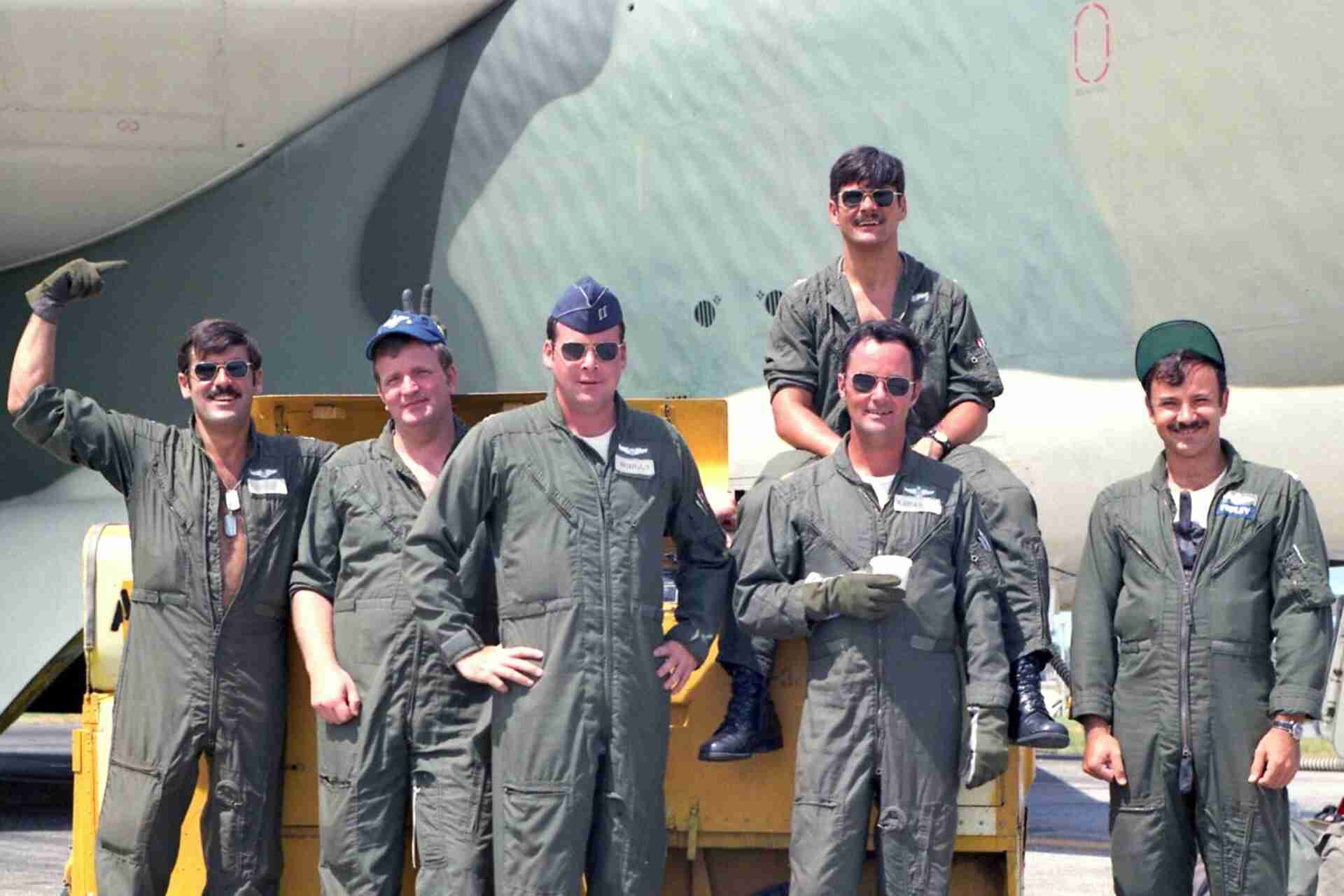
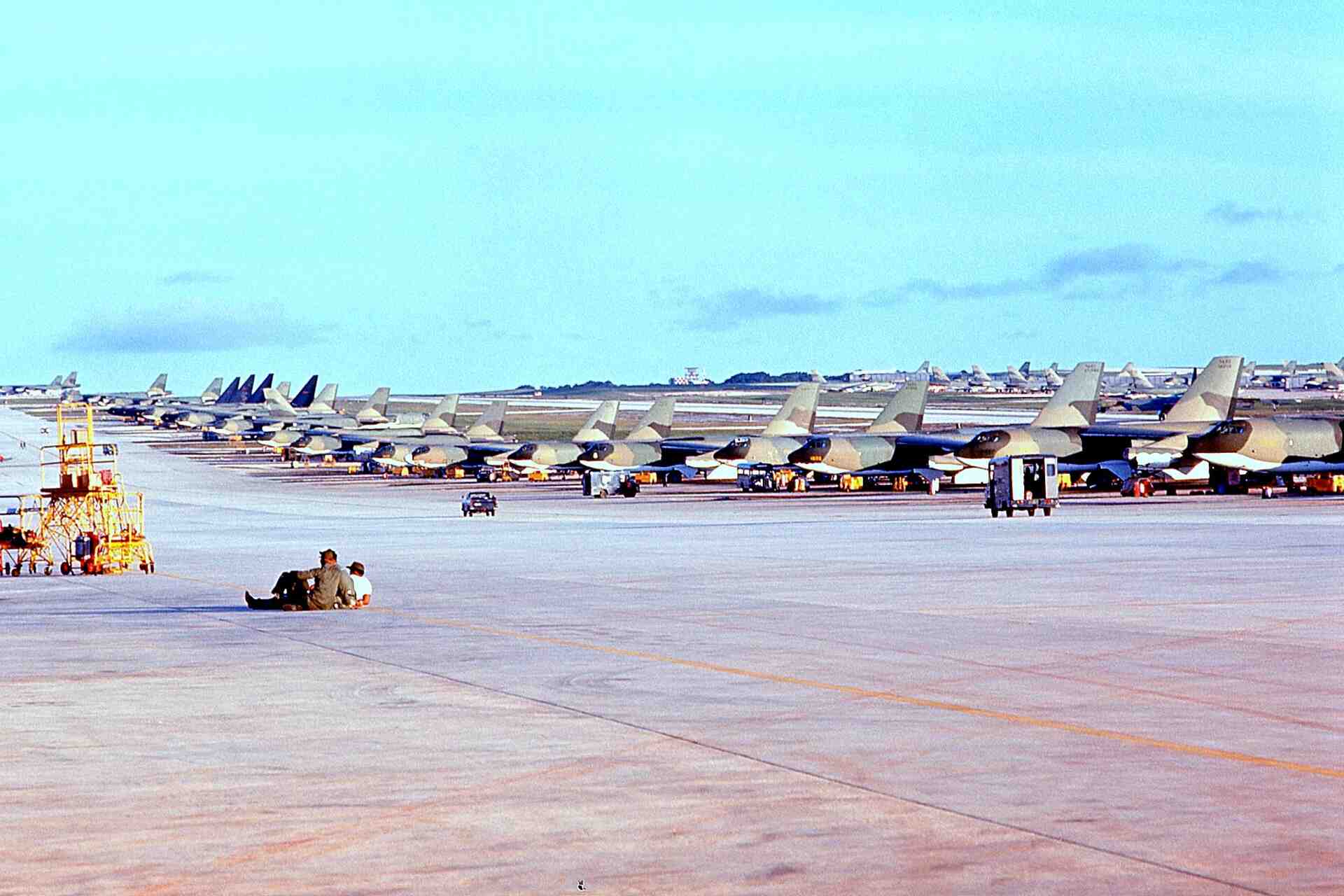


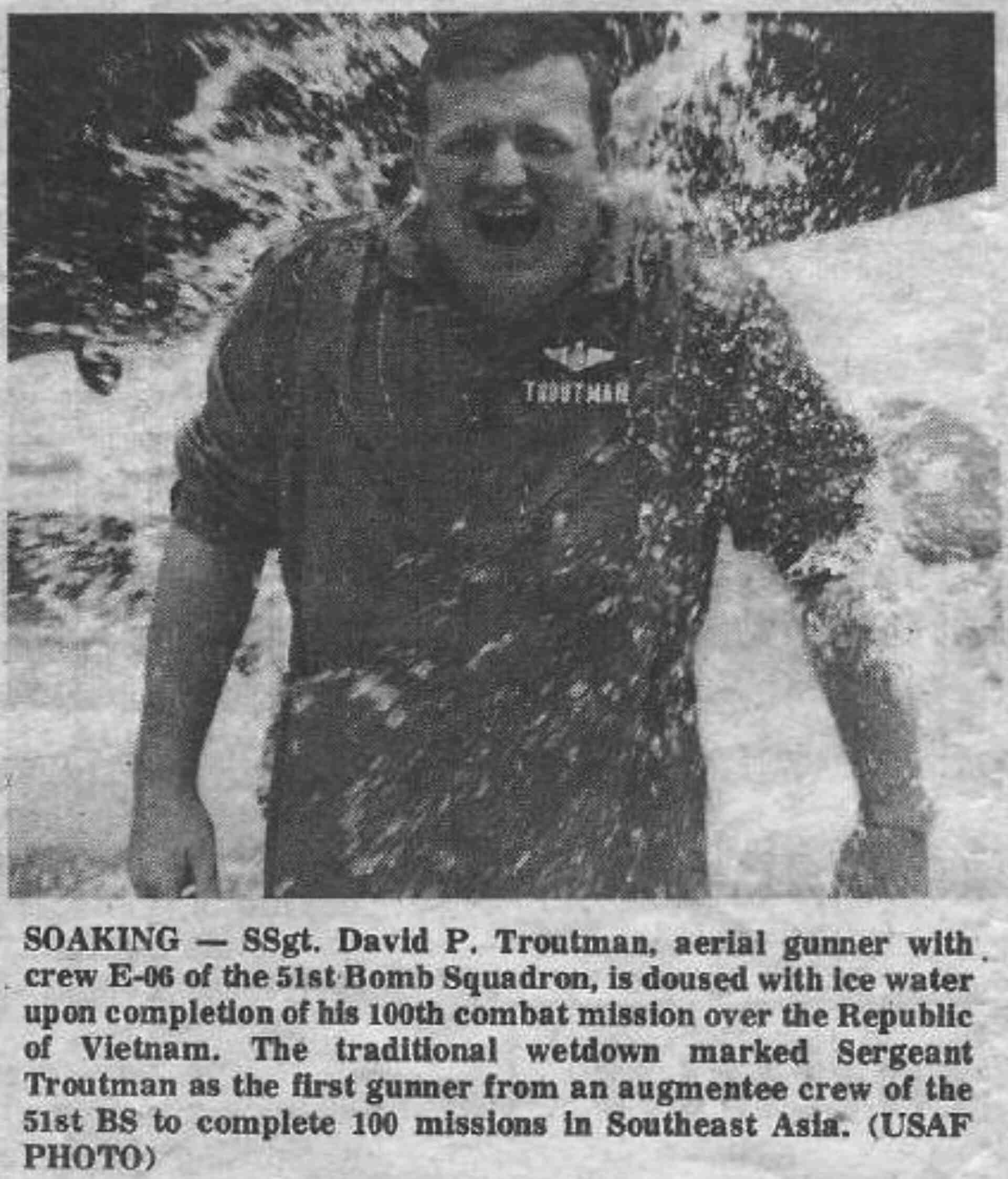


Today, we’re honoring Master Sergeant David P. Troutman, USAF, retired. What did he do during that fine career? Well, his was a very interesting job: He was an aerial gunner, a tail gunner on the B-52.
His main task was defending his B-52 against aerial attacks, a job description that instantly conjures up visions of ultimate combat showdowns in the stratosphere. However, more often than not, it was a job that entailed spending endless days on alert duty or, tallying up countless hours in the air on training missions.
And all that flying could seem to some to have been a pointless exercise. After all, those gunners were not likely to encounter Soviet MiGs lurking over Michigan or North Carolina just waiting to ambush any B-52 that happened by while doing touch & goes in the local pattern. Piled on top of that, there were those critics who chuckled at the idea of the gunners having the ability to defend their aircraft at all…
…which was a mistake made by several MiG pilots who, during the Vietnam War, decided to get too close to the business end of a B-52 and were blasted out of the sky for their troubles. (“C’est la vie” goes the B-52 gunner’s motto)
That is because the gunners were always ready.
All that endless flying in peaceful skies was time well spent. They did not just fly around waiting to pull a trigger; they were quite well-versed in all aspects of defending their aircraft. B-52 gunners were well-trained professionals, members of a dedicated team – a combat crew – and they were more than prepared to assure the completion of the mission by guarding their bomber and their crew/friends.
One of those committed professionals was our man of the hour, Master Sergeant David Troutman. Joining the USAF in 1959, he soon trained as a gunner before embarking on a long career where he served with the following bomb squadrons: 93rd, 716th (both at Kinchloe AFB), the 51st (Seymour Johnson AFB), and the 668th (Griffiss AFB).
Already a highly experienced aerial gunner and Cold War veteran when the B-52s of Strategic Air Command were called upon to take to the skies over Vietnam, Troutman served six combat tours there, including Operation Linebacker I (May- Dec 1972) and Linebacker II (18-29 Dec 1972). The latter was the largest bomber operation since WWII and the last major military operation conducted by the US during the Vietnam War. By the end of the conflict, Troutman had flown over 200 combat missions.
When he retired in 1980, Master Sergeant Troutman had flown over 8,000 hours as an aerial gunner in the B-52B, C, D, E, F, G, and H models. He was awarded the Distinguished Flying Cross for his actions over North Vietnam during Linebacker II. His other combat decorations include nine Air Medals awarded for the many missions he flew in hostile skies. His is a career worth honoring, one that his country and his family can be proud of.
Notes
-
The plump 750-pound bombs were typically carried internally while the 500-pounders were carried on external bomb racks as seen here. Note the “Peace Sign” painted on the fins of one of the 750 pounders.
-
This photo is unusual in that this was a mission where the planes dropped their bombs from a 3-ship, wing abreast formation. A typical B-52 bomb drop was done in a “trail” formation, one after the other.
-
When the last bomber in his “cell” (formation) lost their radar and could not drop, Troutman guided him to the target by using his gunnery radar and a stop watch to accurately guide that aircraft to the target and complete their bomb run. For his professionalism, Troutman was awarded this certificate.

 The Jive Bomber
Thank you for your service MSgt Troutman! My dream job was to be a B-52 tail gunner; however, they were phased out the year before I was old enough to enlist.
LikeLike