The Luftwaffe’s “Ooo-Hoo”

A fast and nimble night fighter, the Heinkel He 219, nicknamed the “Uhu” (“oo-hoo”) or “Owl”, was yet another of the Luftwaffe’s innovative aircraft that, despite being of sound design and capabilities, never made it into mass production. Reason: Like many German planes of the period, the He 219 was a victim of the tangled nightmare that was the Third Reich’s aircraft procurement process, an activity that was a never-ending battle of competing interests, overlapping areas of responsibility, and conflict. Hence, the He 219 was not built in sufficient numbers to have an effect on the air war in the nighttime skies of Hitler’s Germany. 

There’s Always More Forts

Jimmie Mattern’s Vega

What started as a great airplane – the Lockheed Vega – became famous due to its usage in various aerial exploits in the 1930s. One such act of aviation derring-do came from Jimmie Mattern, who used the Vega in his attempts to circumnavigate the globe in 1932 and 1933. Alas, Mattern flew great distances and even set records, but he never made it around the globe; both of his attempts ended with a wrecked Vega in the Soviet Union.

Despite these setbacks, Mattern was one of the great contributors to aviation progress. This is reflected by the fact that when Apollo 11 went to the moon, Jimmie Mattern’s pilot license was carried aboard.

Scorpions

“The Highly Supersonic F-105 Thunderchief”

With the noteworthy exception of not dropping a thermonuclear bomb on invading armies (as was its original purpose), the F-105 Thunderchief, AKA the “Thud” (of course), pretty much performed every role one could think of and a few more as well. However, such achievements came with a price, especially in the skies over Vietnam during the first few years of the war. During that period, the 105 was the primary strike aircraft and had a loss rate to prove it: More than half of the F-105s that saw combat in Vietnam were shot down or otherwise crashed in-country. A poignant example of that loss rate is found in the attached photo, which shows the Thunderchief assembly line in 1960. In that picture, 17 Thuds can be identified by serial number; all would serve in Vietnam. Of those 17 aircraft captured in this random photo, 15 would be shot down. Very grim math, indeed.

Nevertheless, most F-105 guys thought they had the best plane in the world, a bird far superior to anything else that came to replace it (See: F-4 Phantom). These Thud drivers haughtily looked down their noses at any mere mortal who even remotely impugned the legend that was their F-105 Thunderchief.

I will leave you with a joke I heard decades ago from an F-4 pilot.

Q: “How many F-105 pilots does it take to screw in a light bulb?”

A: “Two. One guy to screw in the bulb, the other to talk about how great it was.”

Random Seaplanes, Flying Boats, And Other Things That Float And Fly

James E. Stewart, Flight Engineer

By the time this photo reached “Aunt Olga & Uncle Fred” back in his home state of Iowa, Private James Stewart had completed aerial gunner training at Harlingen, Texas, and was now at Keeseler Field in Mississippi for the next phase of his training, that of aircraft mechanic.  Upon graduation from Keesler, newly promoted Sergeant Stewart was off to RAF Sudbury in Suffolk, Great Britain, where he served as a B-17 flight engineer with the 833rd Bomb Squadron, 486th Bomb Group. He flew his missions, survived running gun battles with the Luftwaffe, got blasted by flak batteries, and eventually returned home to Iowa.

Stewart did all these things while still a teenager. 

XB-19A

Vanished: The “Hawaii Clipper”

Martin M-130 Hawaii Clipper

Seen at Pearl Harbor’s Fleet Air Base in 1936-37, this Martin M-130 – better known as Pan Am’s “Hawaii Clipper” – is prepped for its next long hop over the Pacific. Sadly, in 1938, somewhere between Guam and Manila, this aircraft disappeared with all its crew and passengers, never to be seen again.

Conspiracy theories sprang up, ones that continue to this day. Chief among these rumors is that the plane was sabotaged by Japanese secret agents to prevent it from delivering millions of dollars for military aid to China. A more plausible scenario (but less spy thriller) is one where the plane flew into unavoidable severe weather and was destroyed (the last radio contact was interrupted due to weather-related static).

Japanese spies aside, the cause that led to the disappearance of the Hawaii Clipper will probably always remain a mystery.

“O” Is For Observation

As seen here, Douglas Aircraft Company pretty much owned the observation aircraft market for the US Army Air Corps back in the 1930s.

“My Name is Patricia, and the 321st Bomb Wing Voted Me ‘Miss Target'”

This charming young lady, Patricia, wore several hats (including a helmet) back in her modeling days. When not sitting on the wing of a B-47 Stratojet while attending to her responsibilities as “Miss Target” for the 321st Bomb Wing at McCoy AFB, she was busy trying to bite apples from beneath the waves at a local theme park. These vastly different career choices may seem at complete odds, but there was one overriding commonality: both jobs were best performed while wearing a swimsuit.

Note:

“Miss Target”…

Seems a rather ambiguous title, a double entendre, for a USAF organization whose primary mission was to not miss the target.

1930s Candler Field (Atlanta Airport)

The Army Air Corps pays a visit to Candler Field in Atlanta sometime around 1935-36. Although renamed Atlanta Municipal Airport in 1929, one can see by the title of the photo album page that the “Candler” moniker was still unofficially in use. 

There is absolutely nothing left of the scenery captured in these photos – the last of these hangars were demolished decades ago.

Top Cover for America

img056 (1)

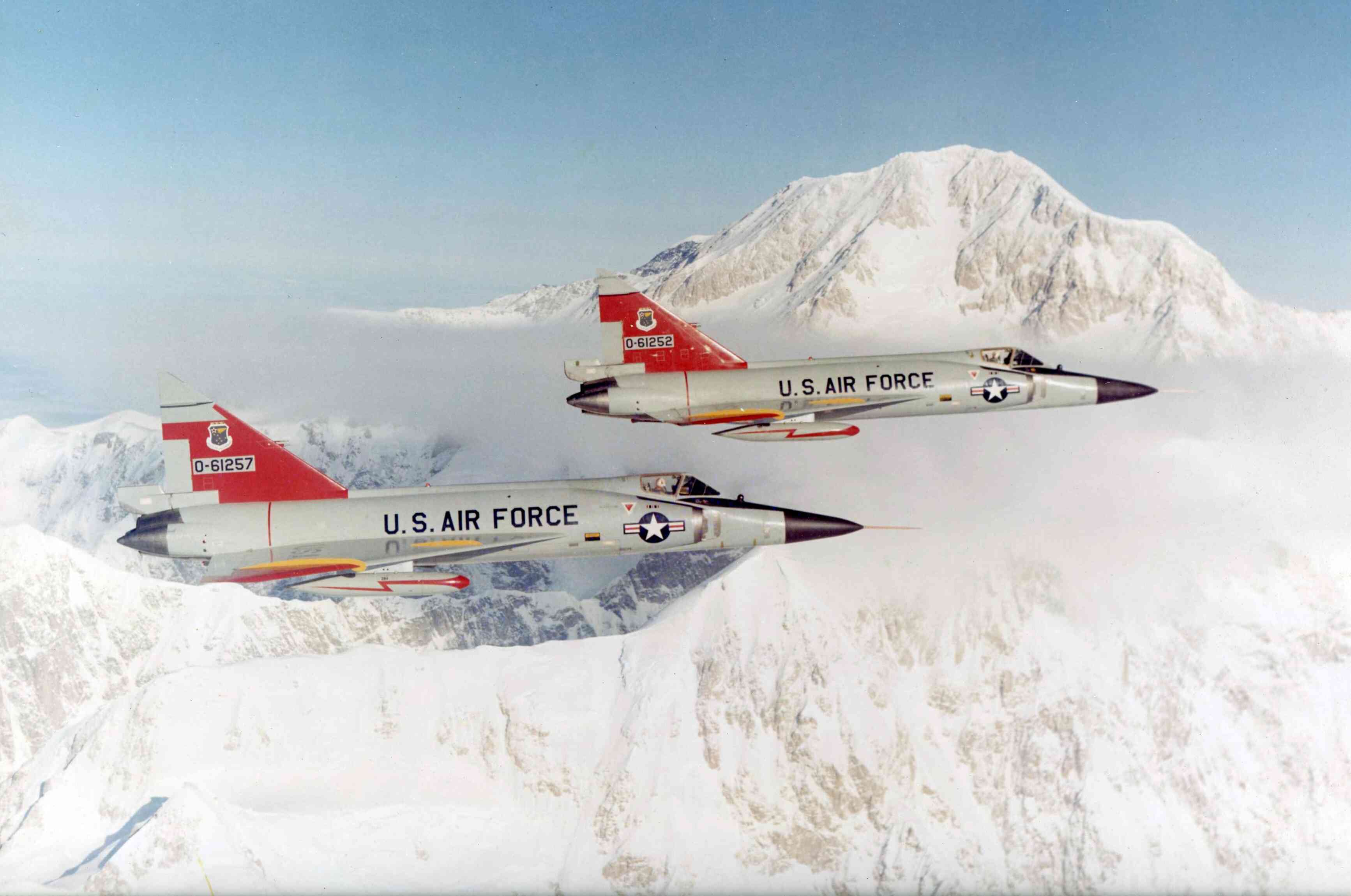
A pair of deuces from the 317th Fighter Interceptor Squadron, Elmendorf AFB Alaska, cruise past the summit of Mt. McKinley in the late 1960s. These F-102s would soon leave Alaskan Air Command and head to the Air National Guard. 56-1257 (foreground) made it as far south as the Wisconsin Air Guard, where, after a few more years of service, the aircraft, like many an F-102, was converted to a drone and blown to smithereens over the Gulf of Mexico.

1257’s wingman, 56-1252, was luckier. It ended up with the 111th FIS, Texas Air Guard, but was spared the drone treatment and was instead put on display at Ellington Field. Notably, this particular aircraft was one of those flown by President George W. Bush when he was a fighter pilot in the 111th.

Weldon Cooke’s 1913 Tractor

Cooke 1913 Tractor (1)

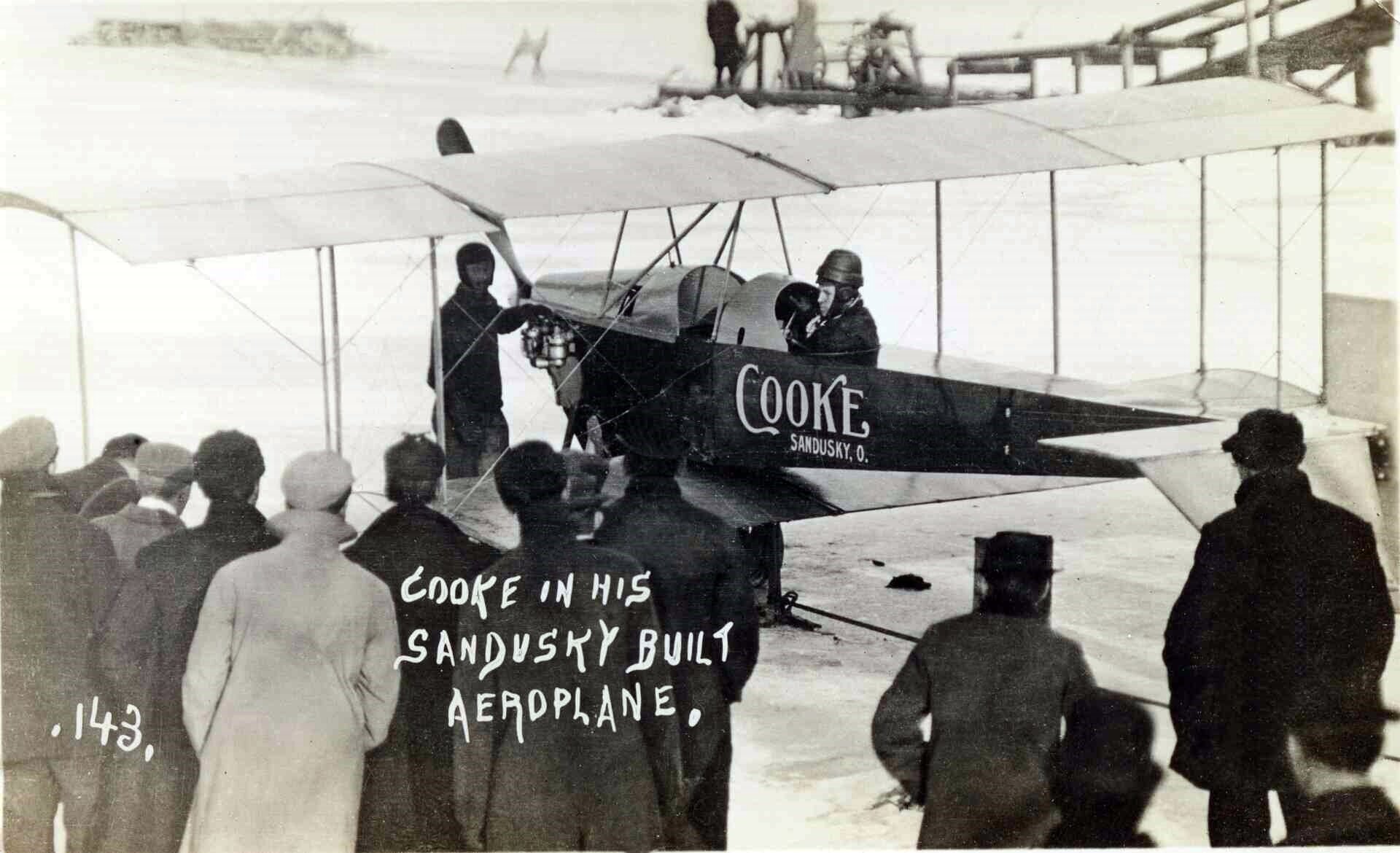
Weldon B. Cooke, seen in the cockpit of his 1913 Tractor Biplane, readies for what will prove to be a successful flight from the lengthy runway of a (conveniently) frozen Lake Erie near Sandusky, Ohio.
Mr. Cooke’s machine was of an advanced design. In the 1913 world, where pilots and passengers perched on the wing of pusher aircraft such as those built by Wright or Curtiss, Cooke’s airplane had two real cockpits and an engine up front. In addition to placing the motor in a position to pull his aircraft, Mr. Cooke found that inverting said aeroplane motor improved both performance and the pilot’s visibility. Many consider this an aviation first (and by far, not an aviation last). Perhaps this is not surprising given that Mr. Cooke, unlike many other aviation pioneers, had a solid engineering background. He was a self-taught pilot as well.
Unfortunately, like many innovative devices, Cooke’s airplane never attracted customers, and Sandusky, Ohio, never became a mecca for aviation manufacturing. This setback did not dissuade Weldon B. Cooke, who persisted in advancing aviation technology until his untimely demise in an aircraft crash in 1914.

From the “Looks are Deceiving” Dept.

The Loening Model 23/S-1 of the early 1920s is a testament that one cannot judge an aircraft solely by its appearance. Yes, the Model 23 looked somewhat ungainly in its design. Yes, it looked far more hydrodynamic than aerodynamic (This outward form would explain the origins of the Model 23’s official name:  “The Flying Yacht”). 

But, as they say in the Looks are Deceiving Dept…

In actuality, the awkward-appearing “Flying Yacht”, was an amazingly efficient airplane. First taking to the sky in 1921, Loening’s bird won multiple awards for its design – including the Collier Trophy. It also set world records for speed, distance, and altitude. To top it off, the Model 23 was one of the first monoplane-configured seaplanes to go into production. 

Loening’s “Flying Yacht” was quickly eclipsed by the rapid advances in 1920s aviation, but for a brief shining moment, it was unquestionably among the top seaplanes in the world. 

Hellcats

The B-17″E”

The War Can Wait…

NAA P-51B 43-12093_

Los Angeles, Mines Field, 1943. When the ice cream man arrived, work came to a halt outside North American Aviation’s plant.

The pair of Mustangs are an interesting duo: the first P-51 “B” model (43-12093), and an RAF bird (FX863, also a “B” model). 43-12093, befitting its first-in-the-series status, was retained by NAA for test purposes. (Notice it is experimenting with a three-bladed propellor). Our Mustang III, FX863, never made it to the RAF but was instead handed over to the USAAF and eventually saw combat in the skies over Europe with the 357th Fighter Group.

The B-52 A-Model

A grand total of three B-52A’s were built. Here, according to the accompanying citations, are all three of them.

The B-52D

One of Curtiss’s Countless Hawks

img884

Over the years, Curtiss built the following:

Hawk, Hawk I, Hawk II, Turkeyhawk, Goshawk, Seahawk, Sparrowhawk, Goshawk (again), Hawk III, Hawk IV, Mohawk, Tomahawk, Kittyhawk, Warhawk, Seahawk (also again). Oh, and Curtiss also built a Hawk I for the Gulf Oil Company. It was named, you guessed it, the Gulfhawk.

The aircraft seen here is the P-3A (Hawk).

If “Hawk” could be tacked onto a word (or supplemented with Roman numerals) then Curtiss would immediately do so.