Still sporting its USAF markings, 51-7066 is seen soon after its arrival in 1969.
Joined by other Boeing products new and old: a Model 247, and a 747 (5th one built for TWA).
As the B-47 fleet was retired in the mid-1960s, it occurred to Boeing that despite having built over 2,000 Stratojets for everyone else, they didn’t have one to call their own. This issue was happily resolved when the USAF handed its last operational B-47 (by then converted to a WB-47) to Boeing in 1969. That bird, 51-7066, is, of course, still at Boeing Field today, where it is proudly parked in front of the Museum of Flight.
Now preserved in Alabama, 54-0102, a B model, was the fifth F-105 built.
Original and superlative-packed caption for the previous photo.
Two B models flying by “robot control” (See the following caption)
“Jetbuilders” at work. F-105D assembly line,1960.
F-105s on the ramp at Seymour Johnson AFB. The base also hosted B-52s, as seen in the background.
Outnumbered by a host of F-4E Phantoms, this F-105G visiting Seymour Johnson in the late 1970s is nearing the end of its days.
With the noteworthy exception of not dropping a thermonuclear bomb on invading armies (as was its original purpose), the F-105 Thunderchief, AKA the “Thud” (of course), pretty much performed every role one could think of and a few more as well. However, such achievements came with a price, especially in the skies over Vietnam during the first few years of the war. During that period, the 105 was the primary strike aircraft and had a loss rate to prove it: More than half of the F-105s that saw combat in Vietnam were shot down or otherwise crashed in-country. A poignant example of that loss rate is found in the attached photo, which shows the Thunderchief assembly line in 1960. In that picture, 17 Thuds can be identified by serial number; all would serve in Vietnam. Of those 17 aircraft captured in this random photo, 15 would be shot down. Very grim math, indeed.
Nevertheless, most F-105 guys thought they had the best plane in the world, a bird far superior to anything else that came to replace it (See: F-4 Phantom). These Thud drivers haughtily looked down their noses at any mere mortal who even remotely impugned the legend that was their F-105 Thunderchief.
I will leave you with a joke I heard decades ago from an F-4 pilot.
Q: “How many F-105 pilots does it take to screw in a light bulb?”
A: “Two. One guy to screw in the bulb, the other to talk about howgreat it was.”
Found the photo in a USAF flying magazine from the late 50s.
Underwater Miss Target (R) takes aim at an overhead apple.
This charming young lady, Patricia, wore several hats (including a helmet) back in her modeling days. When not sitting on the wing of a B-47 Stratojet while attending to her responsibilities as “Miss Target” for the 321st Bomb Wing at McCoy AFB, she was busy trying to bite apples from beneath the waves at a local theme park. These vastly different career choices may seem at complete odds, but there was one overriding commonality: both jobs were best performed while wearing a swimsuit.
Note:
“Miss Target”…
Seems a rather ambiguous title, a double entendre, for a USAF organization whose primary mission was to not miss the target.
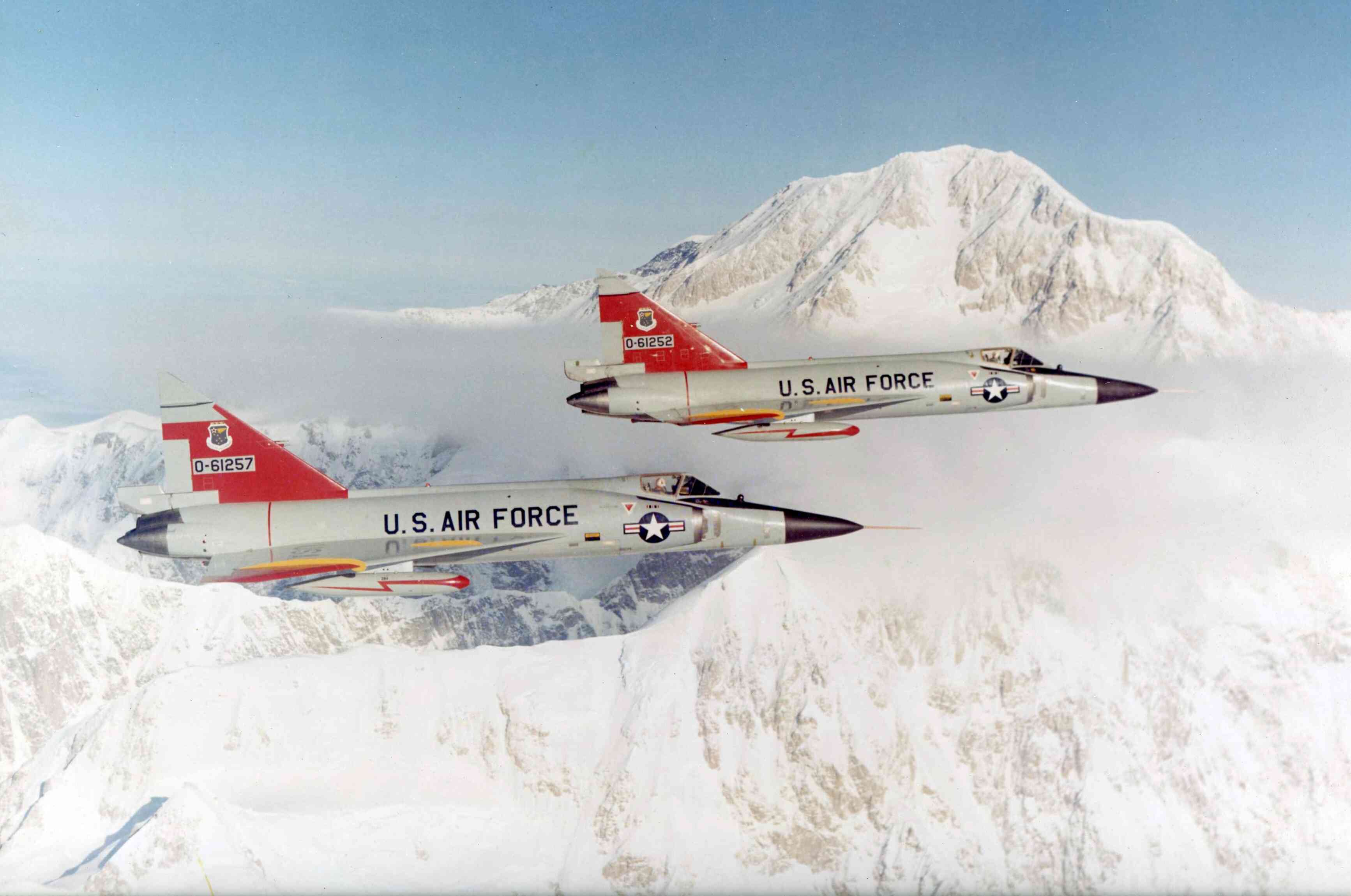
A pair of deuces from the 317th Fighter Interceptor Squadron, Elmendorf AFB Alaska, cruise past the summit of Mt. McKinley in the late 1960s. These F-102s would soon leave Alaskan Air Command and head to the Air National Guard. 56-1257 (foreground) made it as far south as the Wisconsin Air Guard, where, after a few more years of service, the aircraft, like many an F-102, was converted to a drone and blown to smithereens over the Gulf of Mexico.
1257’s wingman, 56-1252, was luckier. It ended up with the 111th FIS, Texas Air Guard, but was spared the drone treatment and was instead put on display at Ellington Field. Notably, this particular aircraft was one of those flown by President George W. Bush when he was a fighter pilot in the 111th.
As one can see emblazoned on its side, 55-049 was the first “D” model built at Boeing’s Wichita plant.
56-591 was used for a variety of tests including (unfortunately for its crew) the viability of the B-52 as a low-level bomber. On such a mission, the aircraft crashed 6/23/1959.
The next four photos are of one B-52D, 55-074.
56-0618 of Amarillo AFB’s 461st BW visits Yokota Air Base, Japan, in 1965. Photo courtesy of Max Pashnev.
55-0061 of the 96th Strategic Aerospace Wing in 1971. Aircraft was shot down over North Vietnam the following year. Photo courtesy of Max Pashnev.
An SH-19A Chickasaw displays its abilities before an appreciative B-36 of the 6th Bomb Wing while the latter is on a deployment to Andersen AFB, Guam. The bomber was far from its home at Walker AFB in New Mexico – about 7,000 miles – but that really wasn’t a very big deal for a B-36.
Baseball history fans will undoubtedly know what occasion caused these men in the autumn of 1957 to decorate one of their planes and then throw their hats in the air. For those who don’t know the significance of the situation, here’s a hint: the Milwaukee Braves had just won the World Series. The photo was taken at Davis-Monthan AFB in Arizona, where, as seen in the picture, the men of the 303rd Bomb Wing’s 358th Bomb Squadron included more than a few Milwaukee fans.
In the late 1940s, the USAF made a wise purchase when they ordered a militarized version of the Cessna Model 195 – the LC-126A. Outfitted with floats for service as a rescue bird in Alaska, the USAF never bought the plane in great numbers (only a dozen or so). Still, what it lacked in numbers, it made up for in style because the Cessna 195/LC-126, in this man’s opinion, is one of the most handsome aircraft ever built.
In the photo, 49-1949 of the 10th Rescue Squadron, Elmendorf AFB, Alaska, undergoes riverside maintenance out in the bush. It’s summer, but that only means hordes of mosquitoes – all of whom have a million children – are swarming unseen in the picture. This particular plane was saved for posterity by the Air Force and now resides in the USAF Museum, painted as seen here 75 years ago.
A cheerful pilot of Air Defense Command’s 63rd Fighter Interceptor Squadron proudly poses with his F-86D at Oscoda AFB, Michigan, in the early 1950s. Nice looking airplane, but it was fated to crash in 1955 while serving with the 85th FIS.
The Alabama boys of the 160th Tactical Reconnaissance Squadron present a nice 4-ship of RF-80s.
Later during their service in Germany, the 160th TRS fancied up their aircraft with the addition of lightning bolts.
The indital destination of the 160th TRS was Toul Rosières Air Base in France. Owing to the base’s less than modern facilities (seen here), the 160th was sent to Neubiberg in Germany. The squadron’s parent group, the 117th, remained at Toul flying RB-26s.
RB-26 of the 1st TRS. The pierced steel planking is evidence of why the 160th and their RF-80 jets opted for a more suitable environment for jet aircraft.
Neubiberg was now home to a couple hundred Alabamians.
RF-80s, a T-33, and several F-84s of the 86th Fighter Bomber Wing.
Maintenance men of the 160th.
Pilots of the 160th.
Colonel Jackson, commander of the 10th Tactical Reconnaissance Group confers with Colonel Laven of the 86th Fighter Bomber Group.
I doubt this was a booster for anyone’s career.
There are three aircraft involved, but all were repaired and put back in service.
The 38th TRS was also at Neubiberg. They later acquired many of the 160th’s aircraft.
Another Neubiberg outfit was the 525th FBS.
F-84E’s of the 86th FBG.
A lone F-84E of the 526th FBS.
One of the nice things about flying a recce fighter is you get to take great pictures and then use them to prove the other guy is not as hot a pilot as the thinks.
Visiting B-29.
Another visitor was this RAF PR 10 (WB156) of No. 541 Squadron, RAF Bückeburg, Germany.
The C-119’s were kept busy during the Germany deployment.
Like many of the men at Neubigerg, this Stinson L-5 Sentinal was a World War II veteran.
The “Skyblazers”, the US Air Force’s in Europe aerial demonstration team.
The 160th could put on a good show as well.
When the 117th Tactical Reconnaissance Group(TRG) of the Alabama Air National Guard was activated during the Korean War, its squadrons spent about six months in Europe. Initially deployed to Toul Rosières Air Base in France, the unit found the steel matting and dirt flightline less-than optimal for the 160th TRS and its FOD-sucking RF-80s. (It was fine for the 1st TRS – they had RB-26s). It was decided to send the 160th to Neubiberg Air Base in Germany, where they would share the facilities with the base’s host unit, the 86th Fighter Bomber Group, and their F-84Es. The 160th remained at Neubiberg until de-activated in July 1952. Loaded with souvenir beer steins and lots of memories, they returned home to Alabama.
George AFB, California. One of the early “short tail” F-102’s, 54-1396, also had a short life: after serving with several interceptor squadrons, she crashed while assigned to the 68th FIS in 1960. Looks to be an open house: there’s an F-101A (53-2441) right behind the Deuce.
The B-50’s R-4360 radials were the culmination of piston engine technology.
49-360 was assigned to the 93rd Bomb Wing.
The “Lucky Lady II” of the 43rd Bomb Group was famous for its non-stop flight around the world.
Although a solid aircraft in every respect, the B-50 was overshadowed (figuratively and literally) by the giant B-36, and the newer and more exciting jet aircraft then taking to the skies.
According to this photo’s caption, actress Debra Paget was in Las Vegas, and when asked if she would like a tour of nearby Nellis AFB she simply could not resist. (Obviously, she would only take part in the tour if she could wear a bathing suit and high heels.) Upon her arrival, the Nellis pilots were so impressed with their visitor that they immediately named her “Miss Sonic Boom.” Miss Paget/Sonic Boom was quite the starlet back in the day featuring in films like The Ten Commandments and a movie opposite Elvis. She is now 90 years old.
Skimming the rooftops, a 7th Bomb Wing bird arrives at the Consolidated plant in San Diego.
RB-36E (44-92023) of the 72nd Strategic Reconnaissance Squadron.
Another RB-36E (44-92020) of the 72nd Strategic Reconnaissance Squadron.
B-36J (52-2820) of the 95th Bomb Wing.
B-36H (51-5718) of the 11th Bomb Wing.
An aluminum suppliers dream, a single B-36 rolled and flattened to the thickness of household aluminum foil, would cover over 20 million square feet of property. Many thanks to Mr. Del Chasteen, a good ol’ Texas boy, who supplied most of the photos.
General Eisenhower gets the red carpet treatment. His C-121, 48-614, is now at the Pima Air Museum.
Although defector pilot Mira Slovak gained freedom in America, most of his fellow Czechs aboard his DC-3 opted to return home to their jobs and families.
With the Rhein-Main airflield (and a C-47) behind him, a beaming air policeman poses with a Mercedes taxi.
One of the two C-119s destroyed in a mid-air collision, May 15, 1953.
Tail of the F-84 that brought the two C-119s down.
A few photos from a USAF air policeman during his tour at Rhein-Main Air Base, Germany, during the early 50s. The Ceskoslovenské Aerolinie DC-3 was flown by Mira Slovak when he defected to the West in March 1953. Later, a famed air racer, champion hydroplane skipper, and all-around dare-devil, Slovak was piloting this DC-3 on a routine flight when he locked his copilot out of the cockpit, dove beneath radar coverage, and slipped into West Germany. The aircraft sat at Rhein-Main while the diplomatic niceties were worked out before returning home to Czechoslovakia. (It crashed a few years later.)
The photos of aircraft wreckage are sad reminders of a fateful day in May 1953, when an F-84 of the 22nd Fighter Bomber Squadron plowed into a formation of C-119s, causing two of them to crash as well as the F-84. Although the Thunderjet pilot who caused the mayhem parachuted to safety, eight of the 10 crewmen in the two C-119s were not as fortunate.
Taken at Ladd AFB, Alaska, on Monday, September 17, 1956, the men of the 18th pose with one of their F-89s on one of the few remaining days before the base is buried in snow.
F-84B (46-663, and originally a “P-84”), 49th Fighter Squadron, Jet. Nicknamed “Itsy Bitsy II”, it was the personal jet of George Laval, a former P-38 pilot known for his colorful painted aircraft. This one is pretty tame compared to his WWII birds.
F-86F (52-4850), 366th Fighter Bomber Wing, England AFB.
F-82F (46-453), 319th Fighter Squadron (All-Weather), Moses Lake AFB.
F-89C (51-5826), 107th Fighter Interceptor Squadron, Michigan Air Guard.
F-100C (54-1980), “Skyblazers” Demonstration Team.
RF-84F (52-7265), 407th Strategic Fighter Wing, Great Falls AFB. This aircraft is on display at the Chino air museum.
F-100C (53-1777), 450th Fighter Day Squadron, Foster AFB.
F-102A (54-1390), Air Research Development Command.
F-86A (48-184), 71st Fighter Squadron, Jet, March AFB. Note the extra large “ferry” fuel tanks and the faired-over gun ports. This plane had a short life: delivered in the summer of 1949, it crashed in September that same year.
F-105B (57-5803), Air Research Development Command. This aircraft can be seen today at the March Field Museum, CA.
Men of the 100th Strategic Reconnaissance Wing (SRW) on deployment to Albrook AFB, Panama Canal Zone, pose for a group photo before heading home. The reason for their trip to Albrook was classified: they were monitoring French nuclear tests in the South Pacific. When this photo was taken in ’66, the 100th SRW was new to the “spy plane” world – they had just gained the mission, personnel, and aircraft of the deactivated 4080th SRW (the men are wearing that patch, not the 100th).









 The Jive Bomber