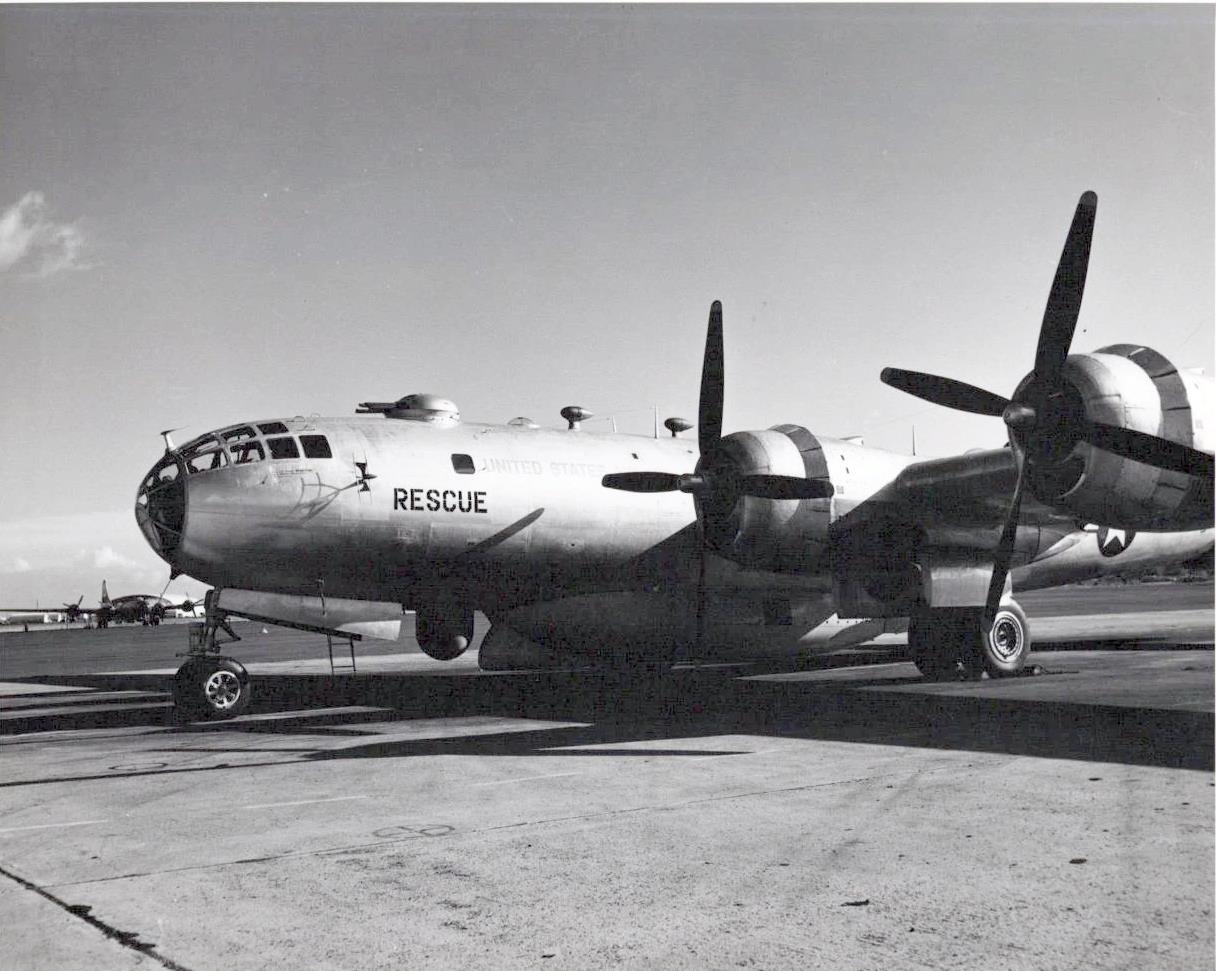
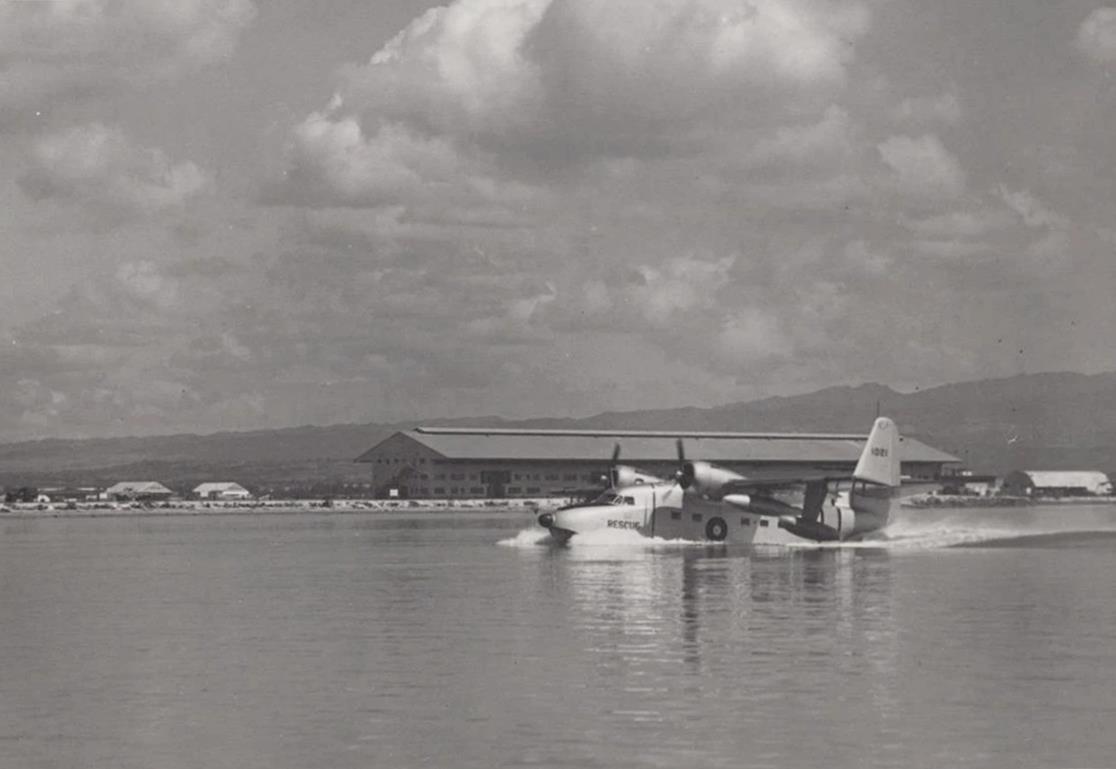
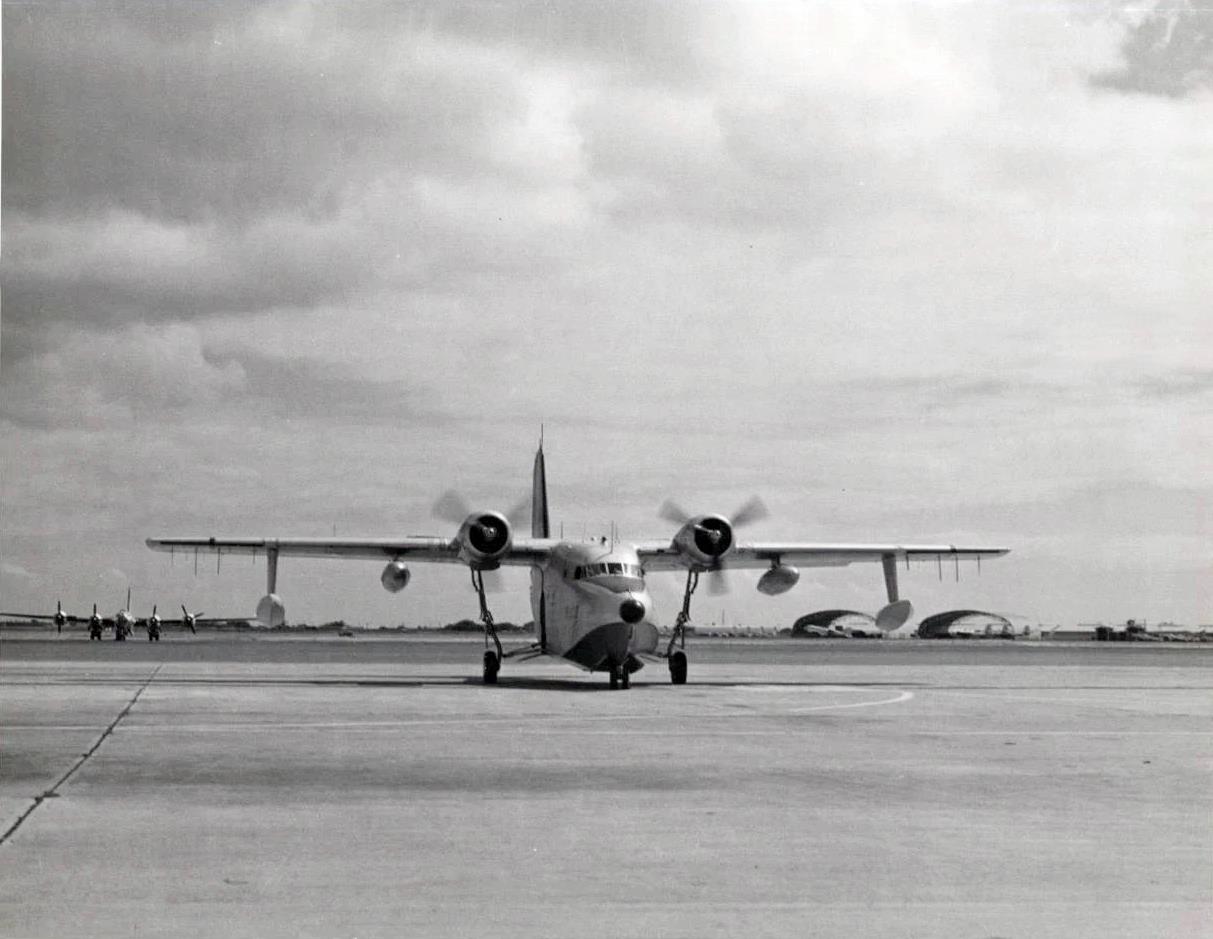
SA-16s and SB-29s of Elmendorf AFB’s 10th Air Rescue Group enjoy a summer’s day in the early 1950s. Given the environment in which these aircraft operated, it is safe to say they stayed quite busy.
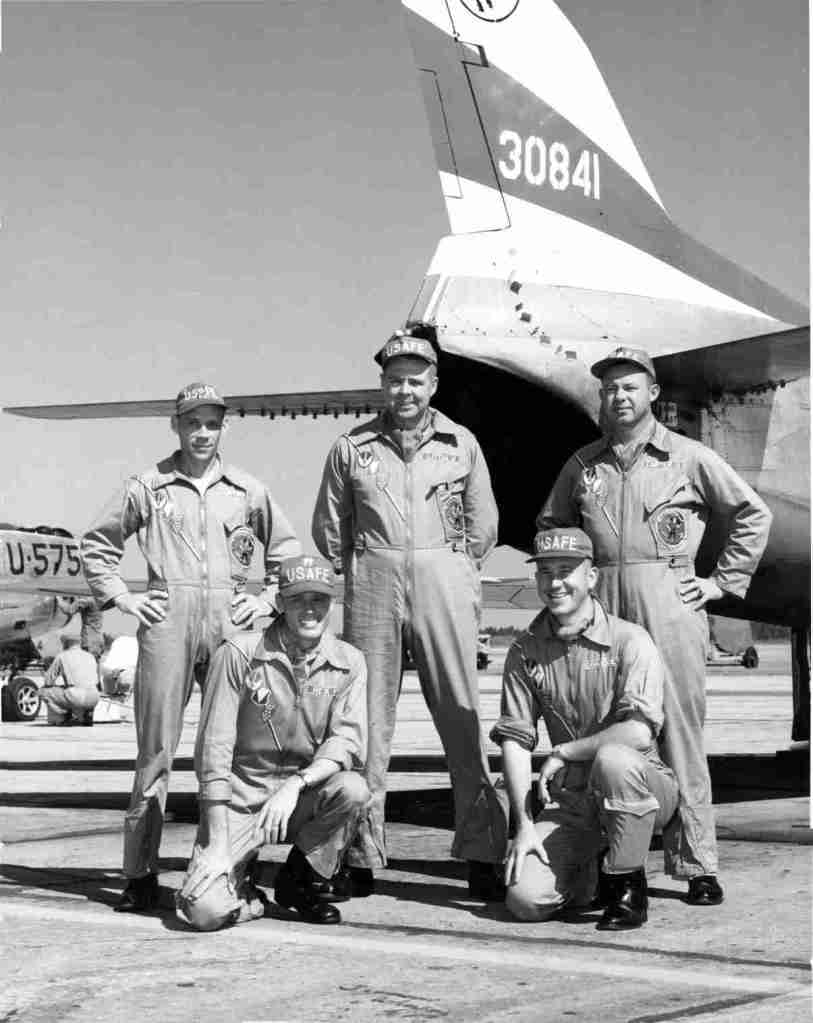
“William Tell”, the US Air Force’s great air-to-air competition, has been held since the 1950s at sunny Tyndall AFB, Florida. Our F-86 pilots depicted above have traveled to said base for the 1958 meet and are obviously looking forward to the various aerial events which will unfold in the coming days. Their home base is Ramstein, Germany; they are members of the 526th Fighter Interceptor Squadron and represent the United States Air Forces in Europe. Note the custom ballcaps and snazzy flight suits made for the competition.
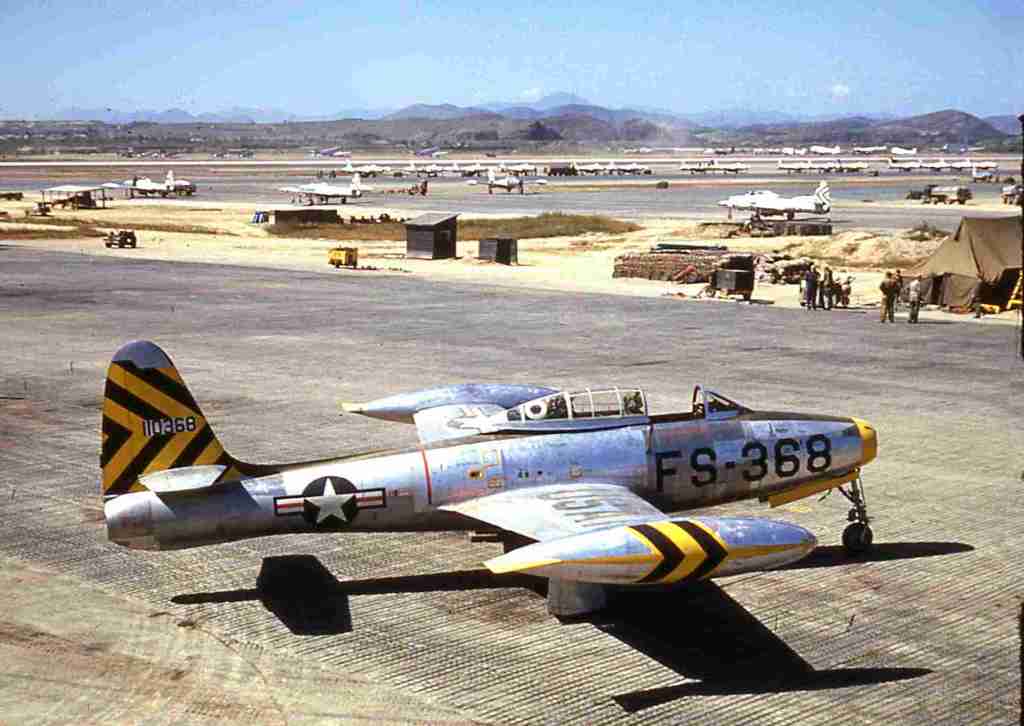
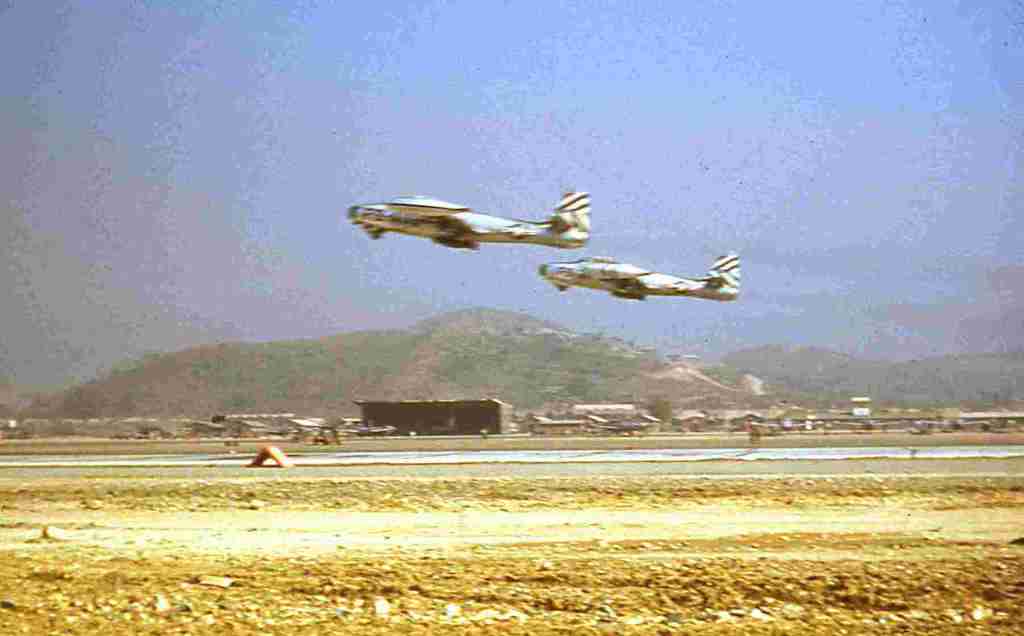
Flightline at Taegu Air Base in 1952. The F-84G, 51-10368, belongs to the 8th Fighter Bomber Squadron, 49th Fighter Bomber Wing.F-84s of the 474th Fighter Bomber Wing, also at Taegu Air Base.
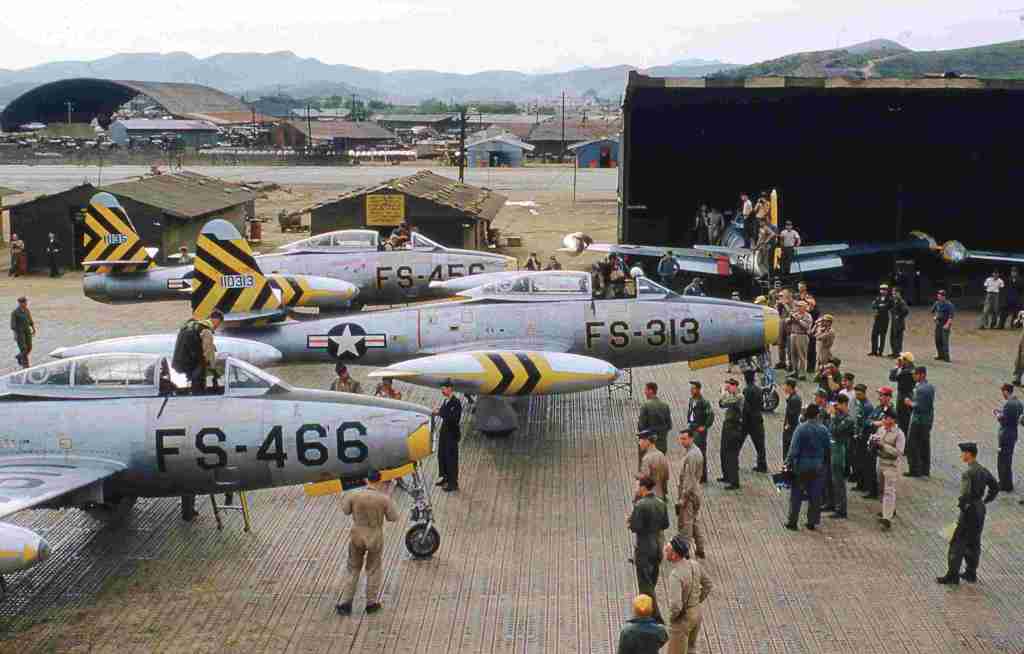
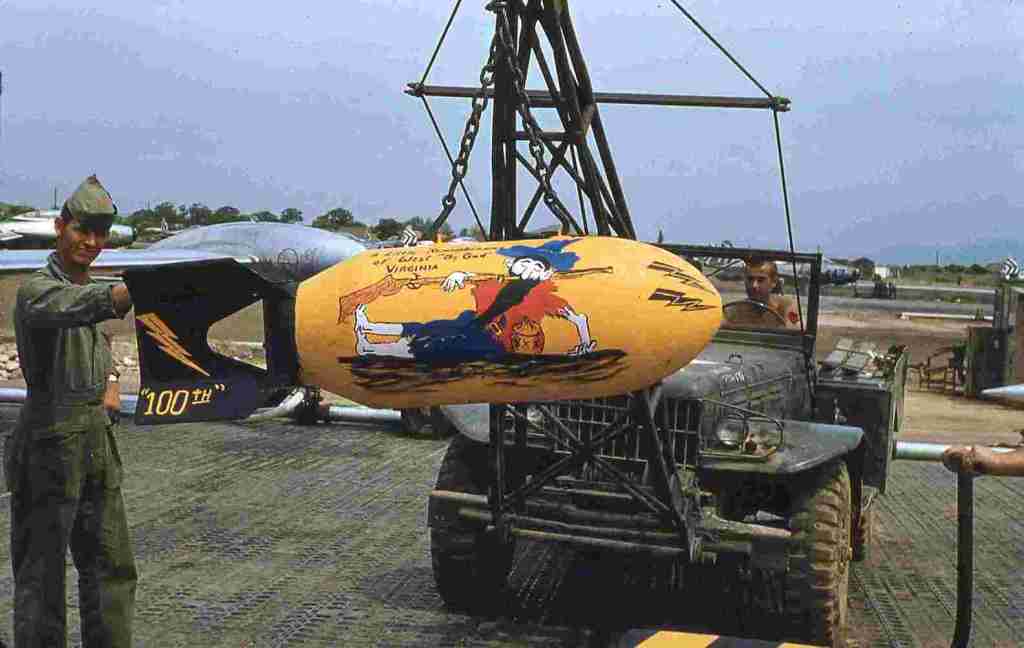
The happy day arrives for three pilots of the 8th Fighter Bomber Squadron: They have flown their 100th mission, and will soon be heading home. A slight curiosity: the rearmost plane reads “456” on the fuselage, but the tail says “51-1135”. Wonder what that story is.Special 100 Mission bomb is readied at the Taegu bomb dump. Besides the Hillbilly paint job, the bomb also reads “A Little Remembrance of West ‘By God’ Virginia”.
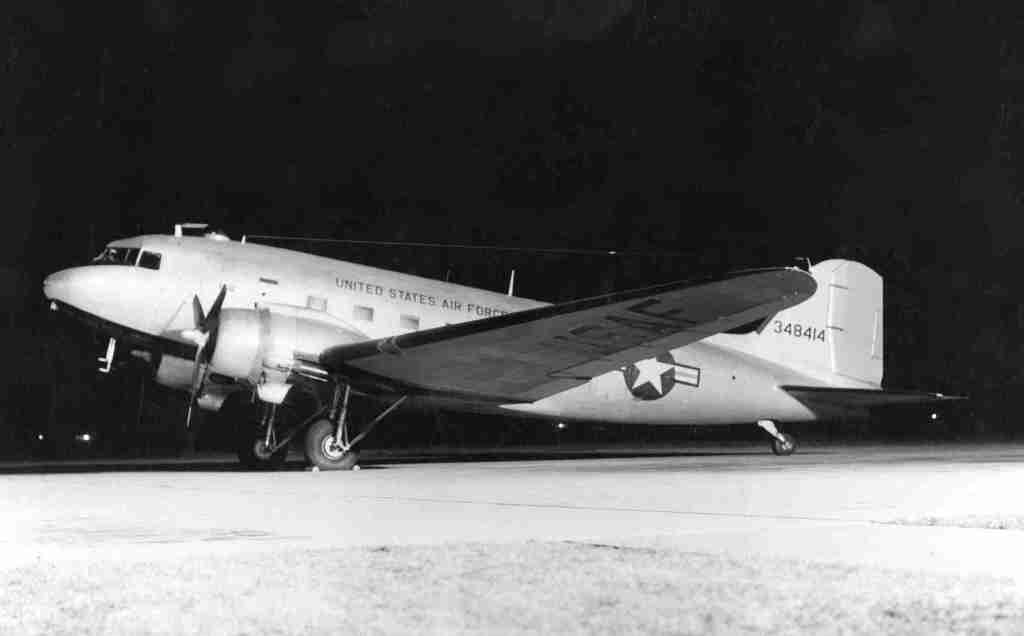
43-48414, a C-47B that looks like any other post-war Goony Bird going about its duties in the US Air Force, is actually a plane with a past. A combat veteran, this C-47 flew multiple missions with the 316th Troop Carrier Group during World War II, most notably in the skies over the Netherlands, dropping paratroopers and towing gliders during Operation Market Garden in September 1944.
The Dutch & Americans have an informal meeting as an F-84F Thunderstreak of the Royal Netherlands Air Force joins up with a USAF T-33 somewhere over Europe in the mid-1960s. The F-84, coded “PP-24” started out with the US serial number 53-6920 before being sold to the Dutch. Note the soot around his gun muzzles.
Bombed up and loaded with 20mm ammo, an early A-37 awaits its next mission.
Size does not always matter. Take, for instance, the Cessna T-37 “Tweet”. Standing only waist-high and with an empty weight akin to that of a large SUV of today, it was nonetheless transformed into a highly lethal warplane, as seen here. The likely location of this photo is Nha Trang Air Base, South Vietnam. This bird began life as a regular Cessna T-37B (56-3465), but after a major overhaul, it emerged as 67-14519, an A-37A Dragonfly.
During the Vietnam War, the skies of Southeast Asia were not limited to aircraft directly involved in the conflict. Life went on for the various air forces in nearby countries, including the Royal Air Force based in Singapore. Here, one of their aircraft is paying a visit to Pleiku Air Base in South Vietnam. The plane is, of course, a Gloster Javelin – a FAW9R from No. 60 Squadron, RAF Tengah. May 1967 is the date on the photo.
Note the variety of USAF birds: C-123s, an F-100, and an RF-101. There was a war on.
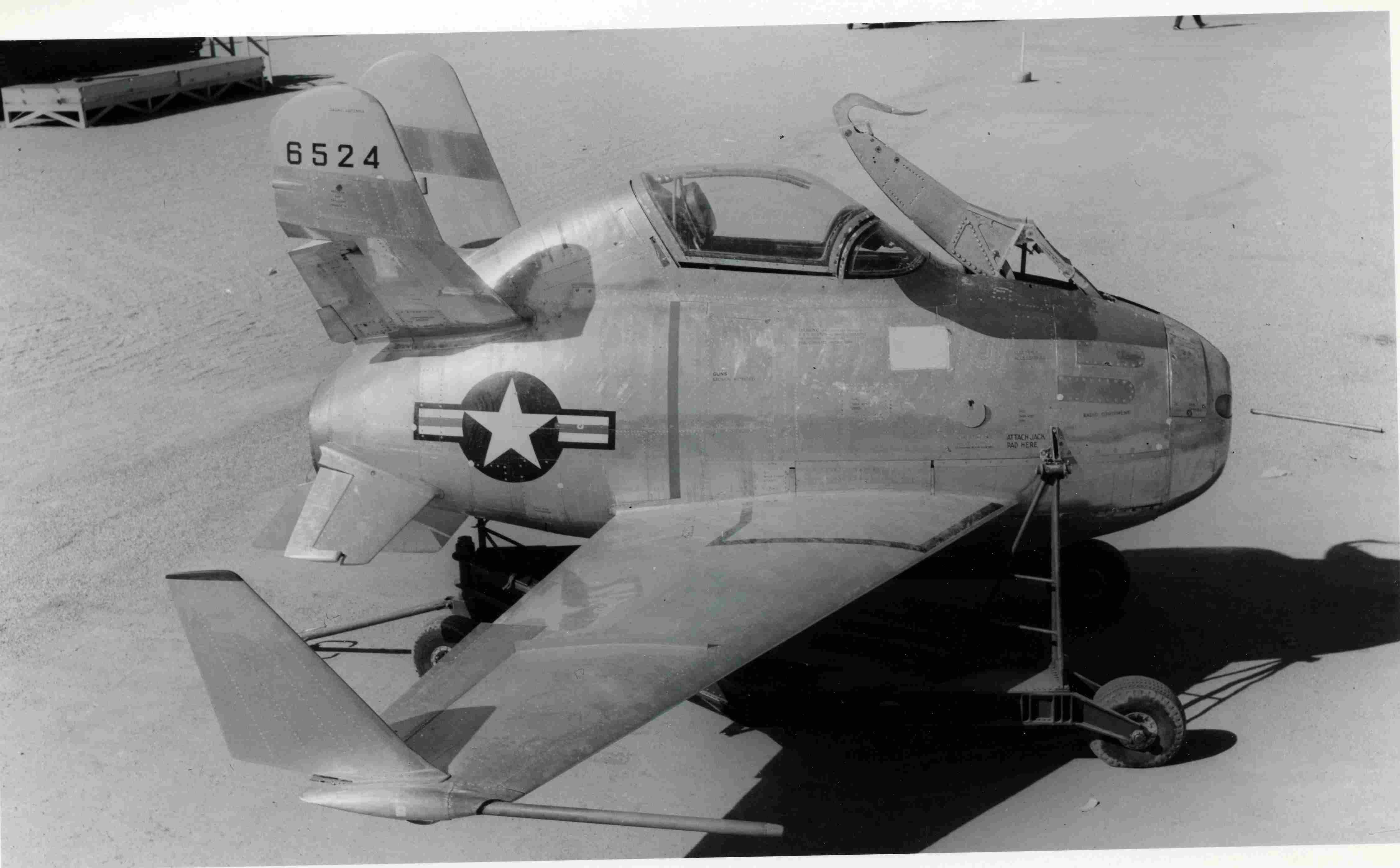
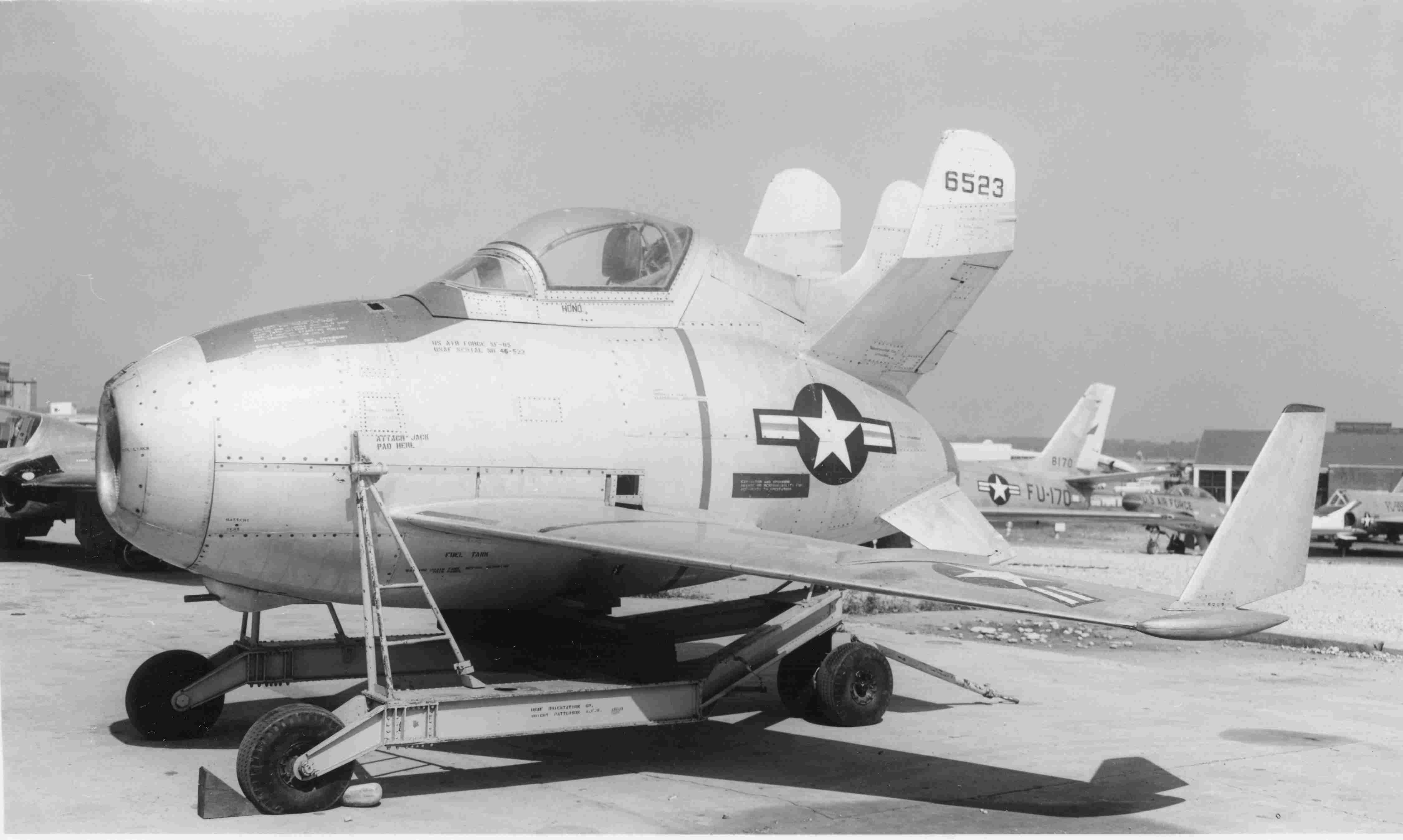
Designed to be hauled through the skies while clinging to a bomber, the McDonnell XF-85 didn’t work too well in that role, but it could claim honors in the category of Most Unusual-Looking Aircraft. McDonnell built only two XF-85 Goblins, both of which are seen here, and both of which can be seen today in museums.
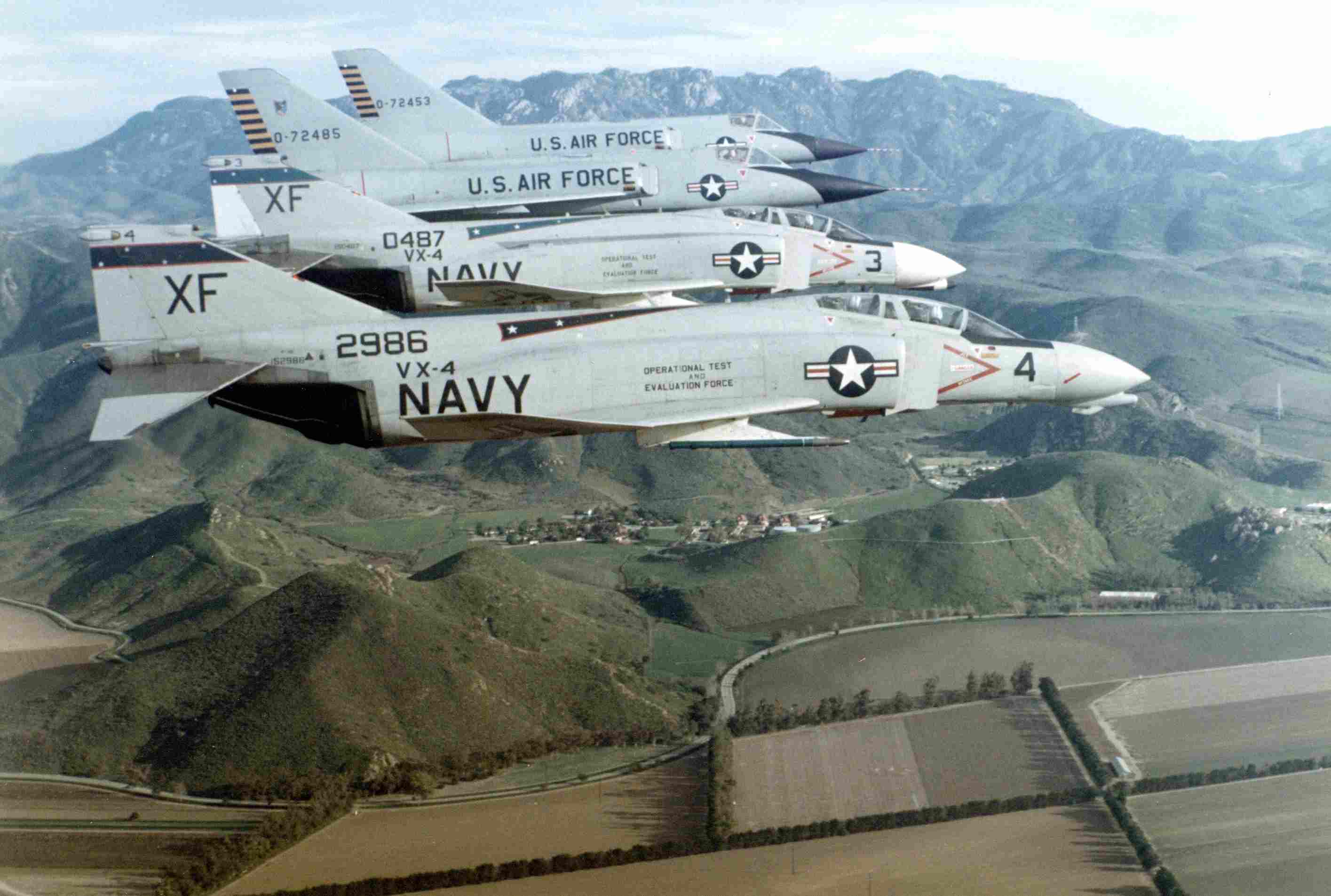
Home to the US Navy’s missile & weapons testing for nearly 80 years, NAS Point Mugu has, during those decades, also been home to a variety of aircraft. A few are seen here. The F-106s were not Mugu birds, but rather visitors from the 460th* Fighter Interceptor Squadron from nearby Oxnard AFB.
*The ‘106s could also be from Oxnard AFB’s 437th FIS – the 460th took over for them and pretty much kept the same markings.
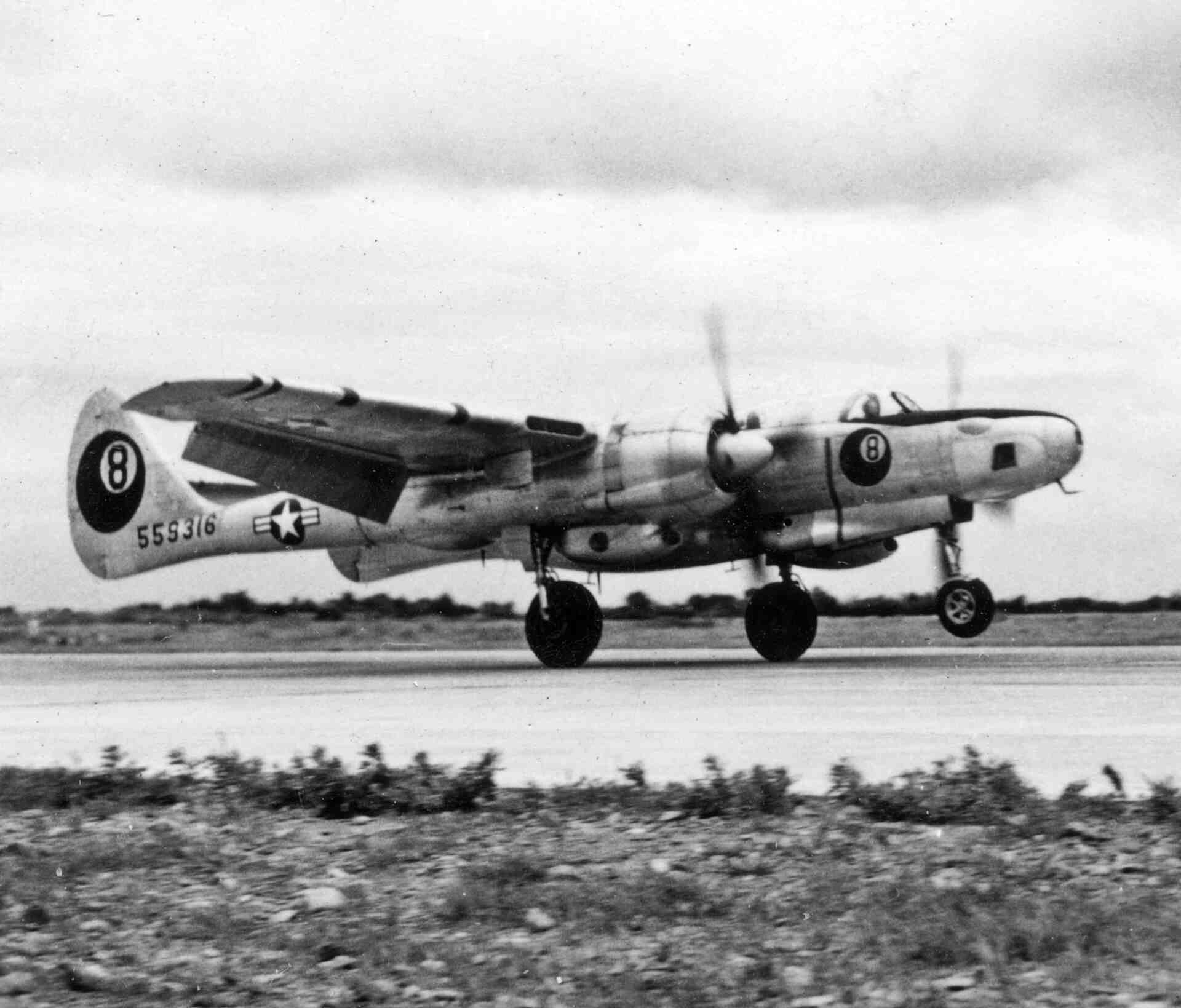
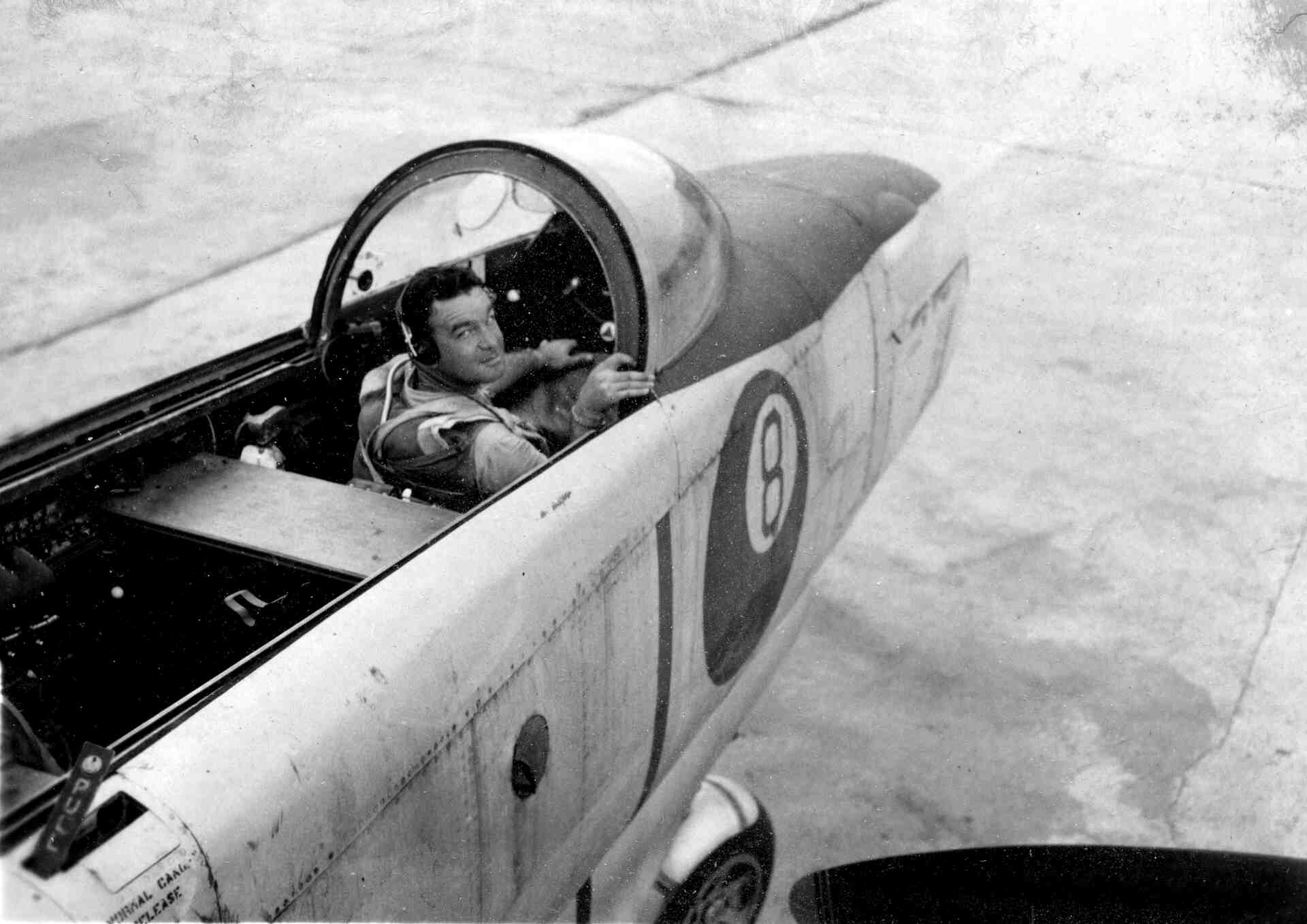
The photo-snapping derivative of Northrop’s much-vaunted P-61 Blackwidow, the F-15A Reporter was dealt by fate an unfavorable hand and did not enjoy the fame of its darker-skinned older relation. First flown in late 1945, with deliveries commencing the following year, the F-15 looked promising, but with the war over and defense spending curtailed, the contract was sharply slashed. Only 36 planes were built. Some were allocated for test purposes, and of the remainder, there was scarcely enough to equip one squadron – the 8th Photographic Reconnaissance Squadron (PRS) of Johnson Air Base, Japan – seen here in the featured photos. The squadron received their F-15s in 1947 and flew them for two years before transferring the surviving aircraft to the 82nd Tactical Reconnaissance Squadron (also at Johnson Air Base), whereupon they were quickly retired.
When, in 1948, the USAF redesignated reconnaissance planes from “F” to “R” (the “F” was needed, of course, to replace the “P” in the fighter world), the F-15 was renamed the RF-61C, thus linking it closer to its forebear, the P-61 (now F-61) Blackwidow. That being said, the designation on the data block below the cockpit in these photos identifies the planes as the “F-15A”. Either the images were taken before the name change, or – this is quite possible given the narrow timeline of service for the aircraft in question – the designation painted on the planes was never changed before they were retired.
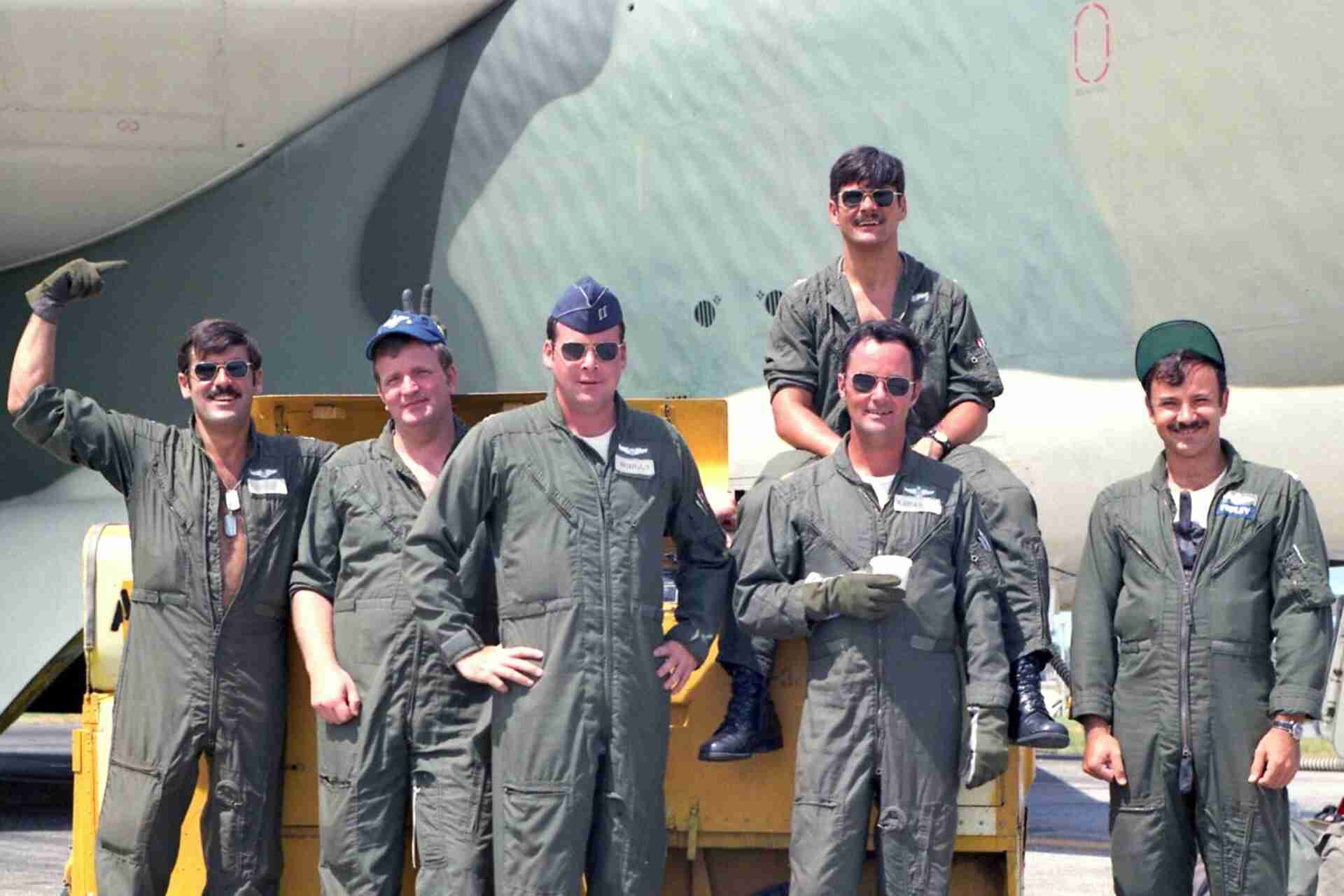
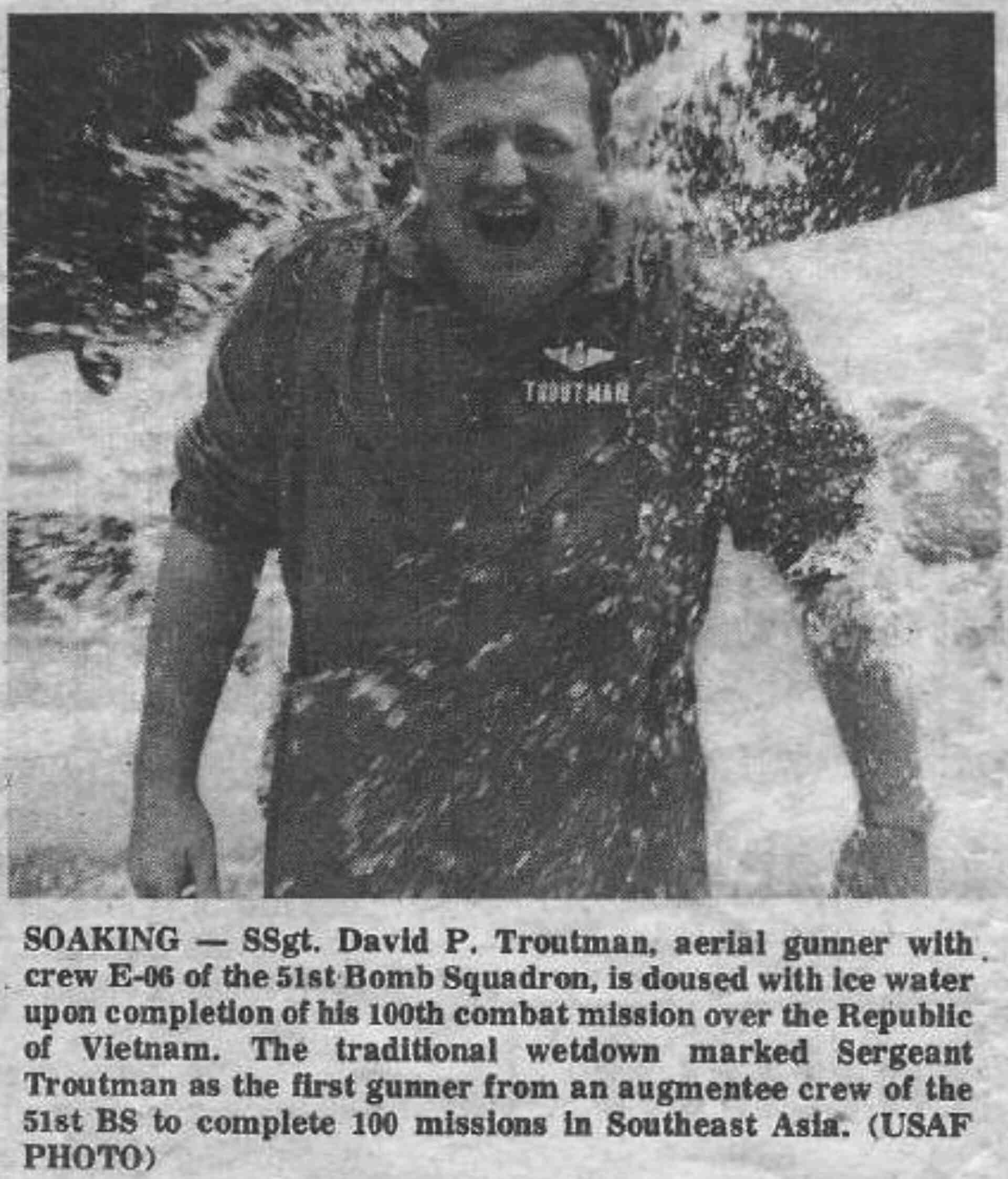
Today, we’re honoring Master Sergeant David P. Troutman, USAF, retired. What did he do during that fine career? Well, his was a very interesting job: He was an aerial gunner, a tail gunner on the B-52.
His main task was defending his B-52 against aerial attacks, a job description that instantly conjures up visions of ultimate combat showdowns in the stratosphere. However, more often than not, it was a job that entailed spending endless days on alert duty or, tallying up countless hours in the air on training missions.
And all that flying could seem to some to have been a pointless exercise. After all, those gunners were not likely to encounter Soviet MiGs lurking over Michigan or North Carolina just waiting to ambush any B-52 that happened by while doing touch & goes in the local pattern. Piled on top of that, there were those critics who chuckled at the idea of the gunners having the ability to defend their aircraft at all…
…which was a mistake made by several MiG pilots who, during the Vietnam War, decided to get too close to the business end of a B-52 and were blasted out of the sky for their troubles. (“C’est la vie” goes the B-52 gunner’s motto)
That is because the gunners were always ready.
All that endless flying in peaceful skies was time well spent. They did not just fly around waiting to pull a trigger; they were quite well-versed in all aspects of defending their aircraft. B-52 gunners were well-trained professionals, members of a dedicated team – a combat crew – and they were more than prepared to assure the completion of the mission by guarding their bomber and their crew/friends.
One of those committed professionals was our man of the hour, Master Sergeant David Troutman. Joining the USAF in 1959, he soon trained as a gunner before embarking on a long career where he served with the following bomb squadrons: 93rd, 716th (both at Kinchloe AFB), the 51st (Seymour Johnson AFB), and the 668th (Griffiss AFB).
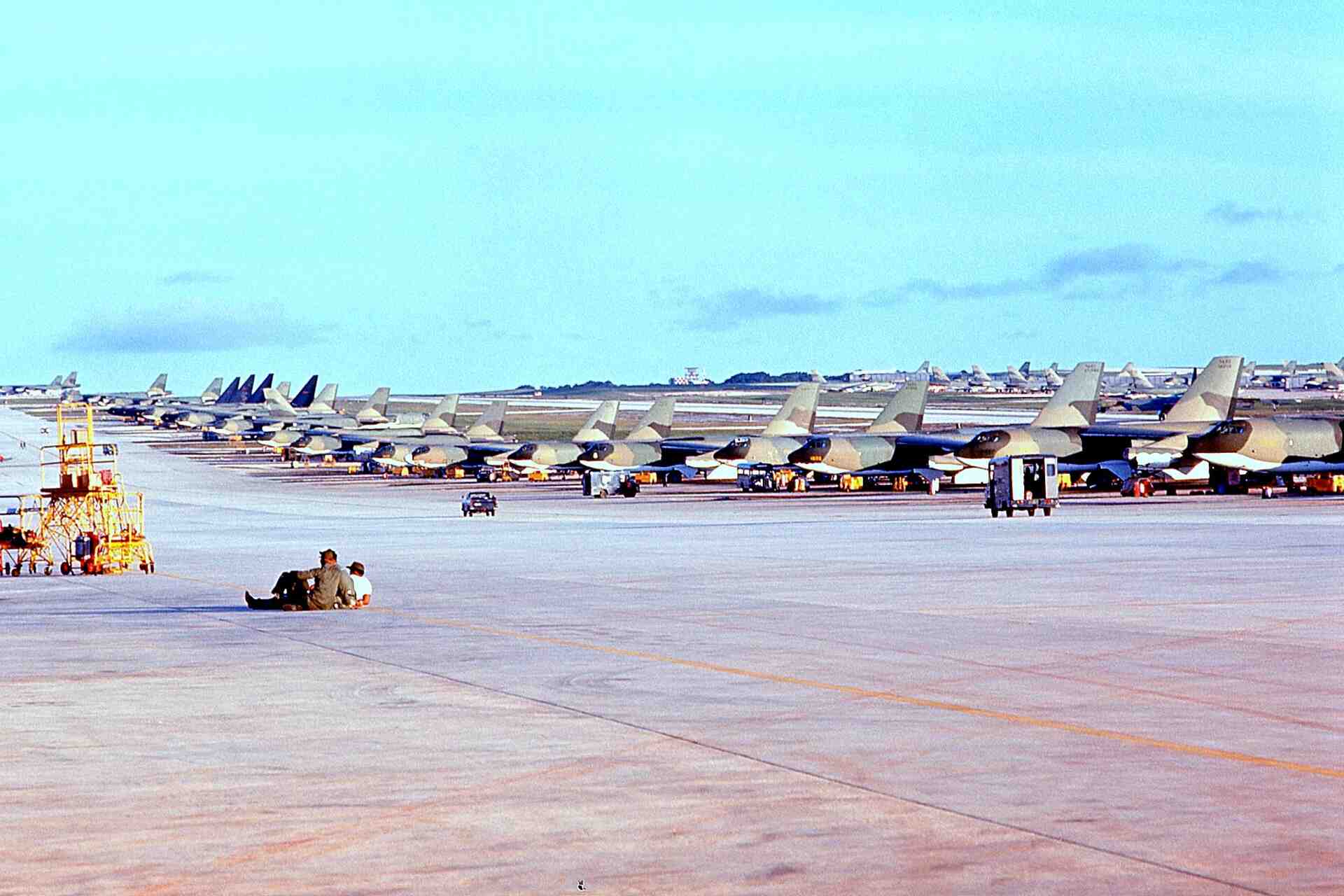
Already a highly experienced aerial gunner and Cold War veteran when the B-52s of Strategic Air Command were called upon to take to the skies over Vietnam, Troutman served six combat tours there, including Operation Linebacker I (May- Dec 1972) and Linebacker II (18-29 Dec 1972). The latter was the largest bomber operation since WWII and the last major military operation conducted by the US during the Vietnam War. By the end of the conflict, Troutman had flown over 200 combat missions.
When he retired in 1980, Master Sergeant Troutman had flown over 8,000 hours as an aerial gunner in the B-52B, C, D, E, F, G, and H models. He was awarded the Distinguished Flying Cross for his actions over North Vietnam during Linebacker II. His other combat decorations include nine Air Medals awarded for the many missions he flew in hostile skies. His is a career worth honoring, one that his country and his family can be proud of.
Notes
The plump 750-pound bombs were typically carried internally while the 500-pounders were carried on external bomb racks as seen here. Note the “Peace Sign” painted on the fins of one of the 750 pounders.
This photo is unusual in that this was a mission where the planes dropped their bombs from a 3-ship, wing abreast formation. A typical B-52 bomb drop was done in a “trail” formation, one after the other.
When the last bomber in his “cell” (formation) lost their radar and could not drop, Troutman guided him to the target by using his gunnery radar and a stop watch to accurately guide that aircraft to the target and complete their bomb run. For his professionalism, Troutman was awarded this certificate.
*These photographs were taken by, and are property of, David Troutman. Provided to this website courtesy of Randy Troutman.
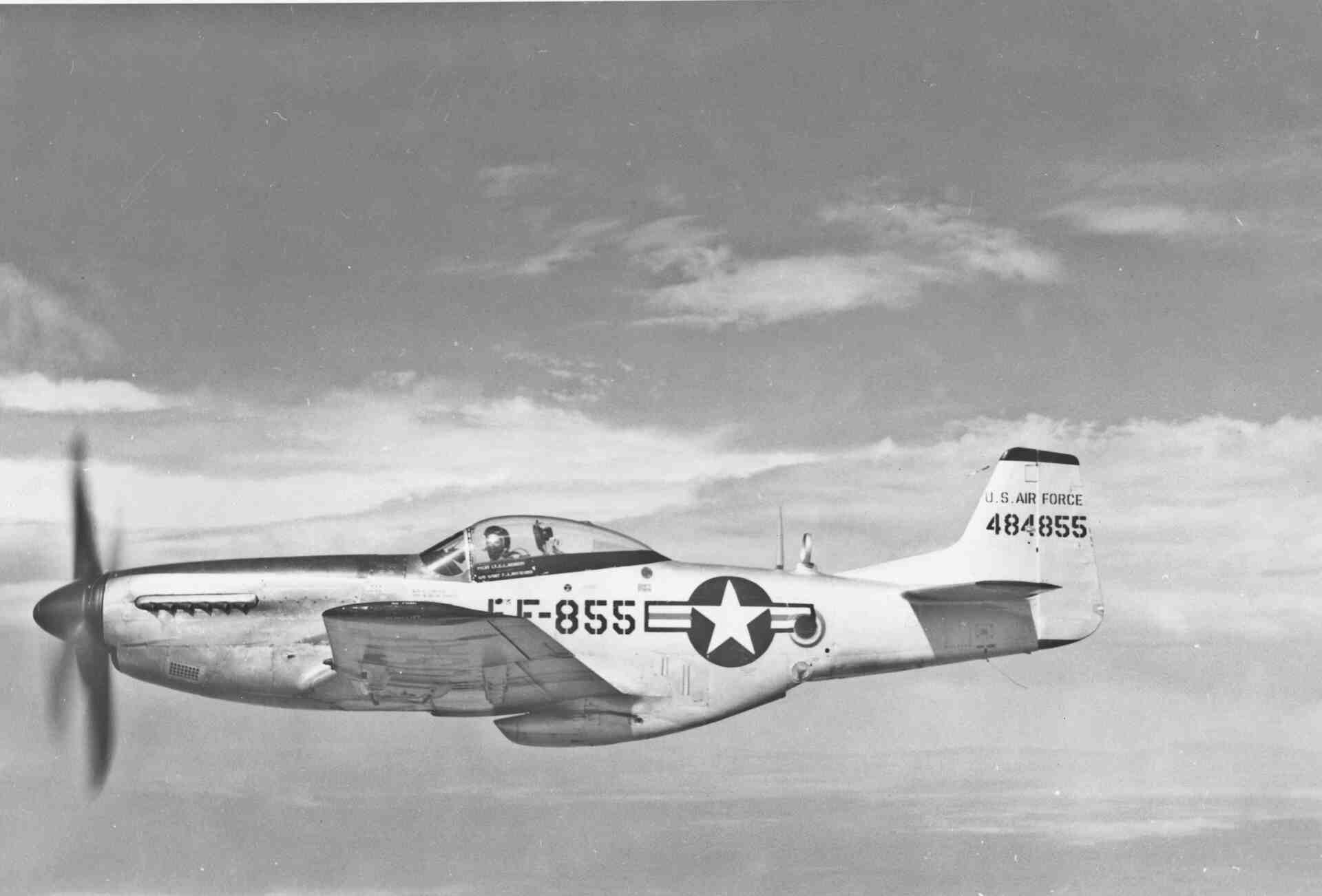
Parked on the ramp at Elmendorf AFB is F-82H 46-384 of the 449th Fighter Squadron, All Weather, a visitor from Ladd AFB, Alaska.
For an airplane built in small numbers (less than 300) and introduced when jets were the center of attention, the piston-engined F-82 Twin Mustang compiled a noteworthy record during its service with the USAF from 1946 to 53.
The USA’s first super-sonic aircraft in Europe: the F-100.
Paris Air Show, 1957.
Paris Air Show brochure.
I believe this is the “Looping en forme de losange”.
Same.
Everything was done in formation.
The team.
Assigned to Bitburg Air Base’s 36th Fighter Day Wing/Tactical Fighter Wing, the F-100C Super Sabre-flying “Skyblazers” wowed millions in the skies over Europe from 1957 to 1962. The team pictured here was led by Captain Bill Creech (later a 4-star general and the namesake of Creech AFB in Nevada). His wingmen were Captains Pat Kramer & Nevin Christensen and Lieutenants Gordon Eells & Gordon Scharnhorst.
A thirsty FJ Fury of VMF 214 nuzzles up to a friendly KB-50.
“Miss Bea” (49-355), a KB-50J of the 622nd AREFS, England AFB.
48-0063, a J-model of the 431st AREFS pulls a pair of FJs and an F8U.
Another shot of “Miss Bea”.
“Pogo” a K-model of the 427th AREFS, Langley AFB.
The term “One of the unsung aircraft…” is often misapplied, but it sticks like glue to the B-50 and its variants. Developed and produced by Boeing at a time when they would rather have been developing and producing jet bombers, the B-50 – basically a well-improved B-29 – was easily overshadowed by more sleek and futuristic designs such as the B-47. And, of course, it would always be comingled/confused with its more famous older brother, the aforesaid B-29. This was aided by the fact the B-50 never even got its own nickname; it too was the “Superfortress”. Apparently, Boeing and the USAF were not interested enough to even come up with a moniker for their new bomber.
Nearly 400 B-50s were built, the majority of which were converted into tankers. Their operations mostly confined to supporting fighter aircraft, the KB-50 became the mainstay of many an Air Refueling Squadron (AREFS) in the 1950s . They soldiered on until 1965, afterwards, they were soon forgotten. Alas, only five B-50s have survived.
Note: Back in the early 1980s, we had an old-timer (at age 40, he seemed ancient) in our USAF maintenance squadron who had worked on KB-50s late in their careers. Patiently puffing (always) on his cigarette, he explained to the youthful ignoramuses in his charge just what a KB-50 was. “Really not much different looking than a B-29” said he. In fact, he recalled that many of the parts were interchangeable.
As previously stated, truly an unsung (and ignored) aircraft (even by those who worked on them).
C-130A, 55-0007, ended up in Bolivia where it rests today.
F-100s on the Wheelus flightline.
F-102A of the 497th Fighter Interceptor Squadron.
F-101C of the 81st Tactical Fighter Wing.
An F-105 visitor from the 36th TFW at Bitburg Air Base, Germany.
Another 105, this time from the 49th TFW, Spangdahlem Air Base, Germany.
C-47 that was assigned to Wheelus for various odd-jobs.
C-54 undergoes engine work.
Here are a few photos taken around 1961-ish. Our photographer was plagued by either a poor camera, or bad picture-taking skills, but he did bless us with a variety of aircraft.
So, about Wheelus Air Base.
European weather is typically not the type one would choose when wanting to fly. The situation was, of course, the same in the 1950s and 60s. Enter Wheelus Air Base. Located right next to Tripoli, Libya, on the sunny shores of the Mediterranean. Salubrious climate aside, Wheelus was an extremely important facility for two other reasons: 1. South of its location stretched an endless desert tailormade for a bombing range. 2. The open skies of the region were well-suited for engaging in air-to-air practice (dogfights).
Given that neither of those aforementioned two factors was readily found in the topography (or skies) of central Europe, the fighter squadrons of the US Air Forces in Europe (USAFE) regularly rotated through Wheelus in order to maintain their qualifications in the air-to-ground and air-to-air missions. According to those who took part in such deployments, a few weeks in Libya was a pretty sweet deal. Plenty to do on the base, nice beaches, and booze was cheap. Also, it wasn’t foggy or snowing.
































 The Jive Bomber