
Category: Army Air Corps & Army Air Service
B-3A in the P.I.

Judging by their dirty coveralls, these mechanics of the 28th Bomb Squadron at Nichols Field in the Philippines deserve some shady rest. And, as seen by the helmet and goggles of the nearest man to the camera, the mechanics did not spend all their time on the ground. The plane is a Keystone B-3, and these men, having gotten the plane ready for flight, will serve aboard as aircrew.
442nd Pursuit Squadron
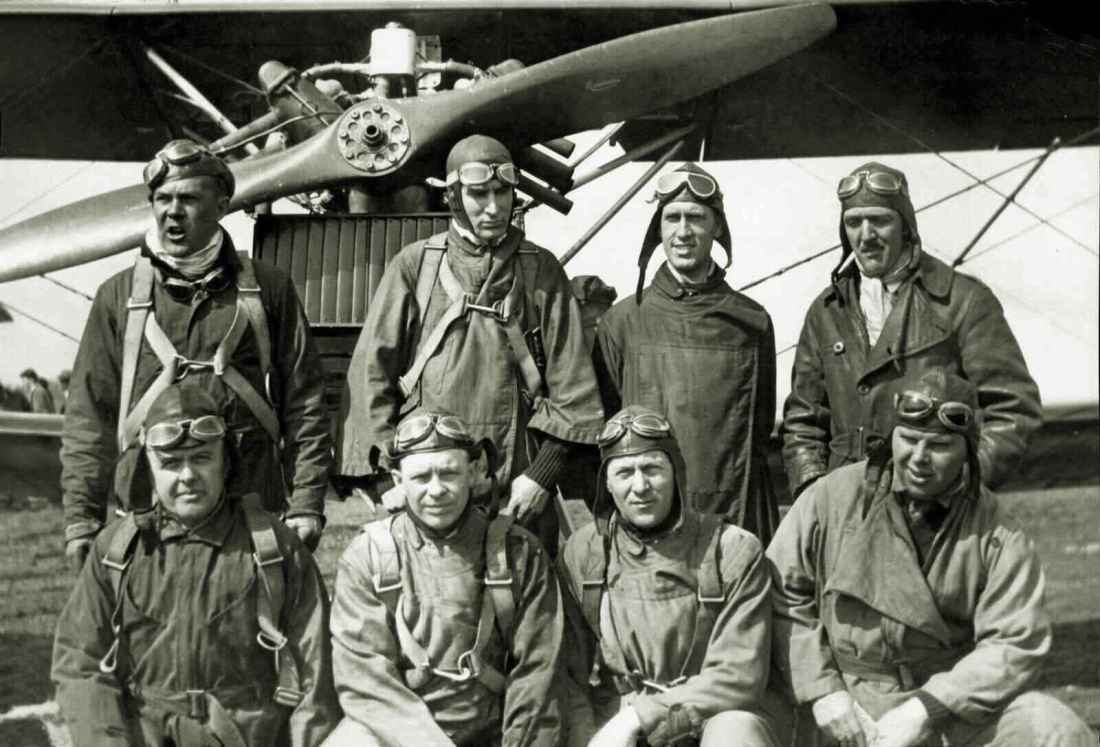
Sporting a wide variety of flying apparel, pilots of the 442nd Pursuit Squadron pose before a Consolidated PT-1 “Trusty” during Air Corps maneuvers circa 1930. The unit was a reserve squadron headquartered in Boston.
Loening OA-1A

“Grace and speed” are not adjectives that come to mind when one glances at a Loening OA-1. On the other hand, the aircraft was incredibly tough and reliable and saw far more years of service than your average airplane of the era. Seen here bobbing on the waters of Lake Gatun in Panama, this bird (26-436) is from the 7th Observation Squadron based at France Field in the Canal Zone. Judging by the smoke stains angling from the exhaust stacks toward the cockpit area, flying could be an aromatic and messy experience. (Like many aircraft of the 1920s, Loening’s OA-1 was not unique in that regard)
And The Name Of The Mystery Airfield Is…


Outlying Field, Mount Vernon, Washington. Today, it serves as Skagit Regional Airport, but when it was constructed during WWII, it was an auxiliary field for NAS Whidbey Island just a short hop away. It continued intermittently as a naval training field but was declared surplus in the late 1950s.
No one had the correct guess, but a couple of frequent visitors to this website knew the name because I had previously shown them the photo. Gentlemen that they are, they kept their knowledge to themselves, refraining from trying to be the most brilliant guy in the room.
Next time you are in the area, stop by and visit the Heritage Flight Museum located at the airport.
6th Squadron (Pursuit)
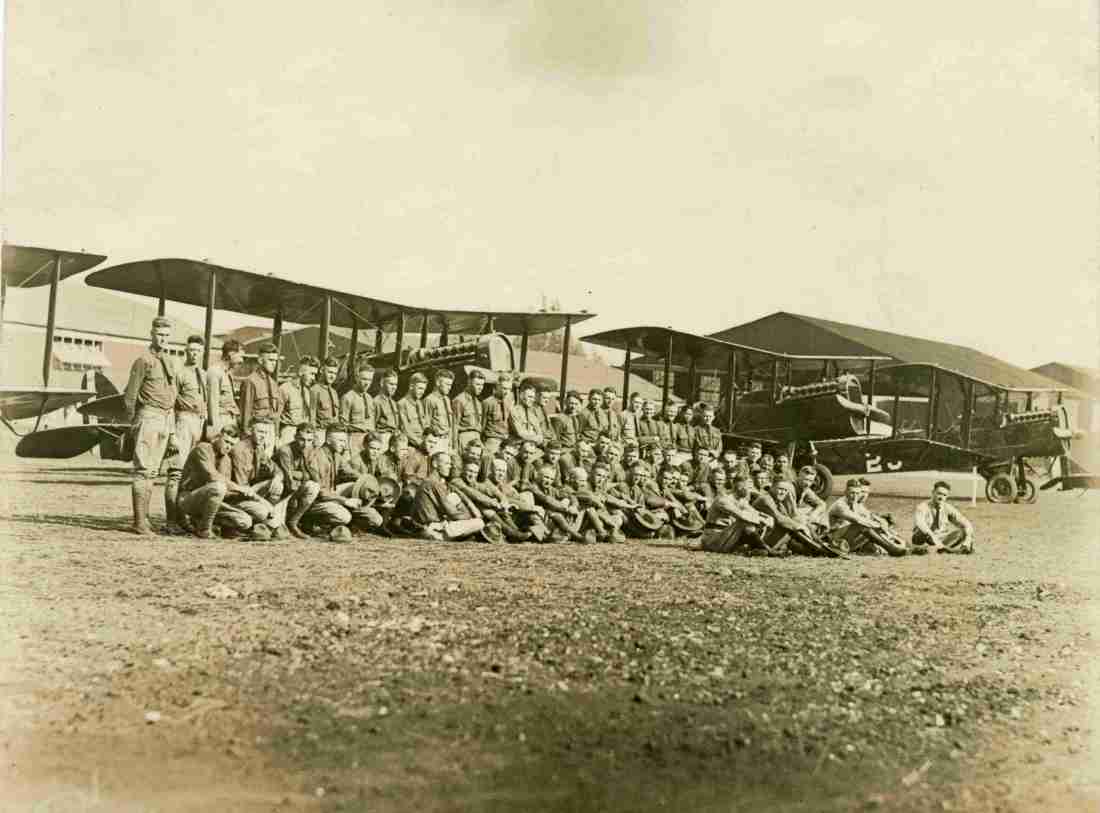
It’s the early 1920s at Luke Field in the Hawaiian Territory, and men of the 6th Squadron take a moment from their busy toils to say “cheese” while posing happily in front of their DH-4s.
The “Hoppi-Copter”

Horace T. Pentecost posing proudly with his invention, the HX-1.


The world envisioned by Mr. Pentecost.
On this Pentecost Day, it is only fitting we mention a man whose name is linked with taking to the heavens and returning to earth: Horace T. Pentecost. In the postwar era, Pentecost toiled on what he thought was sure to be an invention of great value to the people and the military, a lightweight/personal helicopter. A fine idea, but their were difficulties. Among those challenges confronting Pentecost and his HX-1 backpack helicopter was the fact anything less than a perfect takeoff or landing resulted in a disastrously dangerous event involving shards of rotor blades screaming in a hundred different directions. The HX-1 was also very difficult to control, so much so, the only flights made had the machine and its pilot tethered to the earth.
Later models were more stable due to the incorporation of wheels and place to sit, but the late 1940s public (and military) were drawn to the helicopters that were coming off the line from such big name companies such as Bell and Sikorsky.
Mr. Pentecost was no crank inventor; he was an educated man, a wartime Boeing engineer. His dream of a small, lightweight personal means of flight was no different than those who later invented the Ultralight.
The HX-1 was donated to the Smithsonian, and is now on display at the Pima Air & Space Museum in Arizona.
P-36 Hawks of Selfridge Field, Mich.

P-36A with the simple serial number of 38-38 of the 94th Pursuit Squadron. This aircraft’s life was short: It crashed in 1939.

The same aircraft, same day, is joined by his 94th wingman over the snowy farmlands of Michigan.
The “Flying Whale”

B-10B of the 31st Bomb Squadron roars into Boeing Field in 1936.

Still wearing its flight to Alaska markings from the previous year, a B-12A coasts in to Boeing Field, August 7, 1935.

Another B-12A arrives at Boeing Field on the same date.

B-10B of the 11th Bomb Squadron, Boeing Field, July 1936.

August 1936, and another B-10B arrives at Boeing Field.

Martin’s revolutionary bomber attracted instant attention everywhere it went. (Once again, Boeing Field, and once again, August 1936.

B-10B of the 11th Bomb Squadron.

This B-10B seen at Boeing Field wears the markings of the 7th Bomb Group and was the personal plane of LtCol. Clarence Tinker. (Again, the photo’s location is Boeing Field)

Bolling Field.

Aircraft of the 9th Bomb Group, Mitchel Field, NY.

Same aircraft as before. Below them is the Hudson River and the George Washington Bridge.
Despite its unflattering name, the Martin B-10/12 was an absolutely outstanding aircraft for its time. This is especially so when one considers the bombers it replaced: The Keystone series with its (standard for the period) fabric-covered, open cockpit and double-winged aircraft. Whereas most aircraft eased into the transition from the earlier designs (thinking of the P-26), Martin dispensed with the in-between and went next generation.
General Frank Lackland

General Lackland and staff with his personal aircraft, a Douglas B-23.

Sitting in the door, Lackland strikes a friendly pose with his staff. His B-23 bears his insignia as well as that of the 1st Wing.

Autographed photo presented to a member of his staff.
“Lackland” – anyone who has ever served in the USAF knows that name. Billed as the “Gateway to the Air Force,” Lackland AFB in Texas is home to USAF basic training and a host of academic and technical schools. The base’s namesake is seen here, Brigadier General Frank D. Lackland. Like many Air Corps generals, Lackland got his start as a pre-WW1 infantry officer before switching over to the Aviation Section of the Signal Corps. After serving in various capacities, General Lackland became commander of the 1st Wing at March Field in 1939. These photos date from that period. He was likable and friendly, and regardless of rank, he inspired everyone he commanded. It is, therefore, only fitting that the base which introduces recruits to the Air Force is named in his honor.
94th Pursuit Squadron

These men are not going to get any warmer once they get airborne: Rule of thumb for aviation: It gets about 4 degrees (2C) colder for every 1,000 feet higher you go.


A piece of hand-painted insignia.
XB-15 Bomber Bedecked with Bathing-suited Bronx Beauties


Update: Thanks to Paul Martin, author of the multi-volume history Beneath The Shadow of Wings, Untold Stories from Mitchel Field, Long Island, we now learn how dozens of bathing suit-clad women came to be pictured cavorting atop the XB-15. The year is 1940, and Major Caleb V. Haynes and his crew had just been awarded the Mackay Trophy for their exemplary 1939 XB-15 flight that brought relief supplies to an earthquake-devastated Chile. Capitalizing on that fame, the XB-15 made numerous well-publicized visits, including one to Mitchel Field on September 13, 1940.
Enter “Billy Rose’s World’s Fair Aquacade” and his “beautiful aqua-belles”. The “Aquacade” had been a smash hit at the 1939 New York World’s Fair (Johnny Weissmuller of “Tarzan” fame was one of the stars), and in a massive public relations/recruitment event, dozens of these “aqua-belles” were invited to join Mitchel Field officers for a day of fun in the sun while standing atop the Air Corp’s most giant bomber.
Want to learn more about Mitchel Field’s history? Visit Paul Martin’s website https://mitchelfield.weebly.com/for hundreds of great photos and information (you can order his books there too).
Mather Field, April 1930

Plenty to see on Mather’s flightline. Check out the fuel trucks.

The Air Corps’ heavy bombers. I cannot even begin to imagine this many B-52s doing a low pass in such a formation. (Would love to see it though)
The Air Corps loved staging mass aerial demonstrations where – not content with a variety of aircraft in large numbers – entire squadrons (or a major portion of them) would oftentimes take part in the festivities. Such is the case at Mather Field, California, April 3-4, 1930, where flightline promenaders are treated to the sight of eight O-1 Falcons of the 14th Bombardment Squadron and a host of P-12s. The next day came the great fly-by with Keystone LB-6s and Curtiss B-2s.
Peter O. Knight Airport, 1938
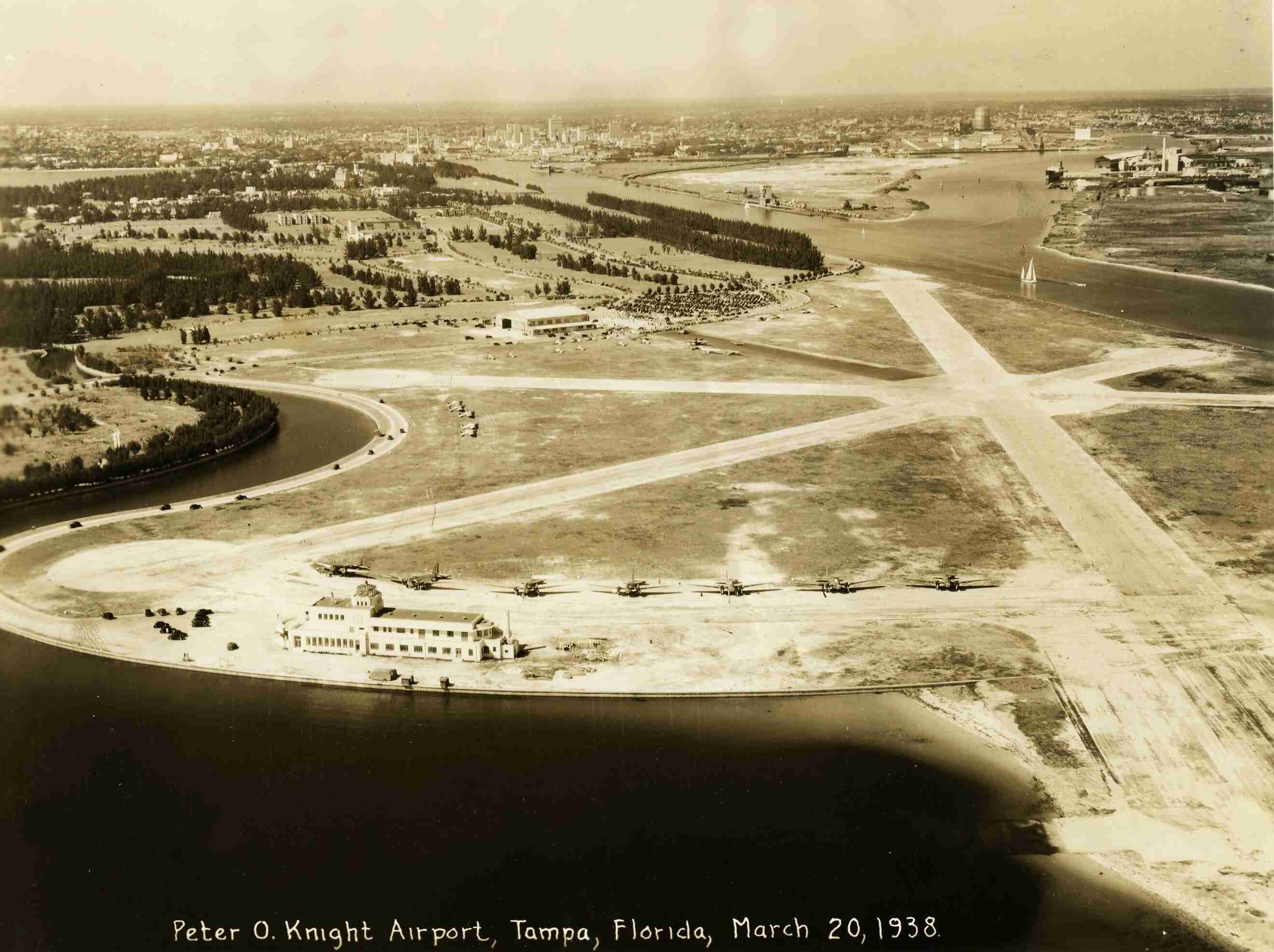
Still busy today with general aviation, Peter O. Knight opened in 1935 as Tampa’s principal airport and remained so until 1945. One of many airports built under the auspices of the Works Progress Administration (WPA), the field boasted multiple paved runways, could handle seaplanes, and had a very nifty art-deco terminal seen in the foreground (unfortunately, now long-gone). When this photo was taken in March of ’38, the main attraction was the bevy of Air Corps planes dotting the field: B-18s, P-26s, P-35s, and a lone B-10.
Master of the Calculated Risk
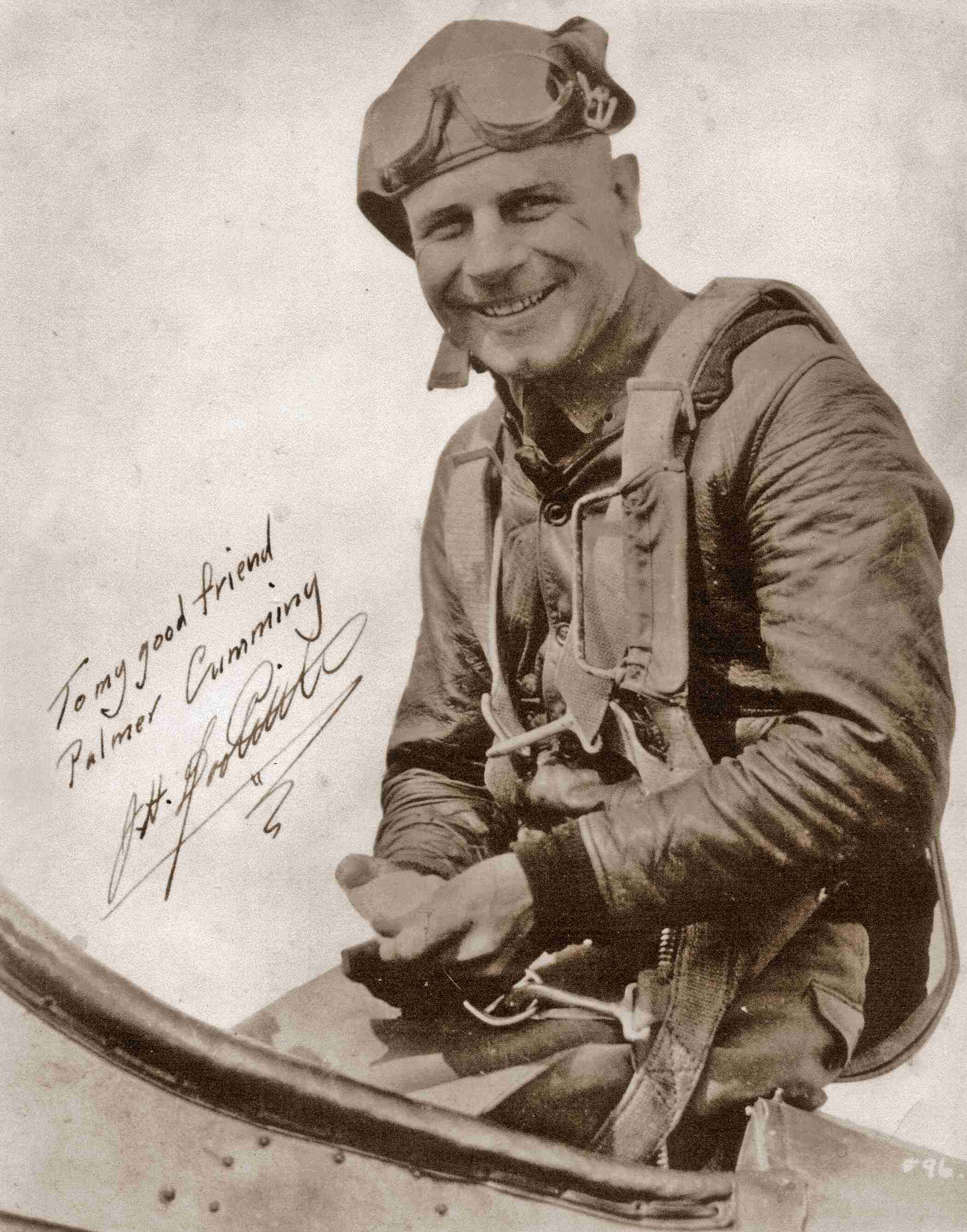
Early autographed photo of Jimmy Doolittle from the time he was speed champion of the world.
The BT-9 and BT-14

BT-9 pitches out over Randolph Field.

Fresh off the assembly line BT-9 at Randolph.

Randolph Field flightline showing BT-9s in one of those photos so dearly beloved by the Air Corps, but required the pilots to broil in the Texas sun while the cameraman got things right.

BT-9 at Langley Field, Va.


Popular Aviation, June, 1939.

The BT-14 was a derivative of the BT-9 and is readily identified by its metal fuselage (the BT-9 was mostly fabric covered).


Connecticut National Guard O-47

The local folks partake in observing the observation planes of their state’s National Guard Aviation Section. These aircraft, seen here in 1939, were assigned to Connecticut’s 118th Observation Squadron.
1st Pursuit Group, 1937


Here we have one of those fantastic panoramic photos that was widely popular back in the day. Taking such a shot was not in the realm of most photographers and so one had to call on the experts: the National Photo & News Service of San Antonio, Texas. It was one of their photographers (E. L. Rothwell) that made the journey to Selfridge Field, Michigan in the summer of ’37. His tool of choice was a “Cirkut” camera, a truly ingenious device that, while pivoting on a level axis, exposed a roll of film which advanced in synchronised movement to the horizontal action of the camera. Capturing for posterity the 1st Pursuit Group required five feet of film (the photo measures 5 feet x 10 inches).
As stated, the photo was taken in 1937. Summer time, if one takes in to account the many open windows and the fully-leafed trees (and, according to the clock on the operations building, it was 9:10 AM). The squadrons are the 17th, 27th, and 94th Pursuit, the aircraft, of course, is the P-26.
Most of these buildings seen 84 years ago are still in use today.
A visit to Selfridge Field, c. 1932

Pilots of Selfridge’s 1st Pursuit Group and their P-12s. As seen by the variety of aircraft in these photos, the 1st flew a mixed-bag of pursuit ships in the early 1930s.

P-6E hawk of the 17th Pursuit Squadron. The background aircraft is a rare P-6A. That airplane, 29-262, crashed on 19 Feb 1933.

Same P-6E as in previous photo. The markings are, of course, well-known and spectacular.

Berliner – Joyce P-16s of the 1st Pursuit Group.
28th Bombardment Squadron, Nichols Field, P.I.

Hickam Field, 1939-40


Mississippi National Guard, 1939

Your well-dressed aerial gunner of the 1930s.

One of the squadron’s pilots is preparing for some aerial gunnery himself. He will not hit a thing, but will have fun trying.

The squadron was new when these photos were taken in 1939, but the aircraft were hand-me-down O-38s. Here, they certainly show their age. This plane, 34-12, was wrecked in 1941.

Time to grease some lifters.

A more modern aircraft assigned to Key Field was this A-17.
The Mississippi National Guard was just starting out in the aviation world when these photos were taken back in ’39. The newly-minted 153rd Observation Squadron took to the skies with a gaggle of decidedly well-worn O-38s, but they were no doubt happy to have something to fly.
By request…
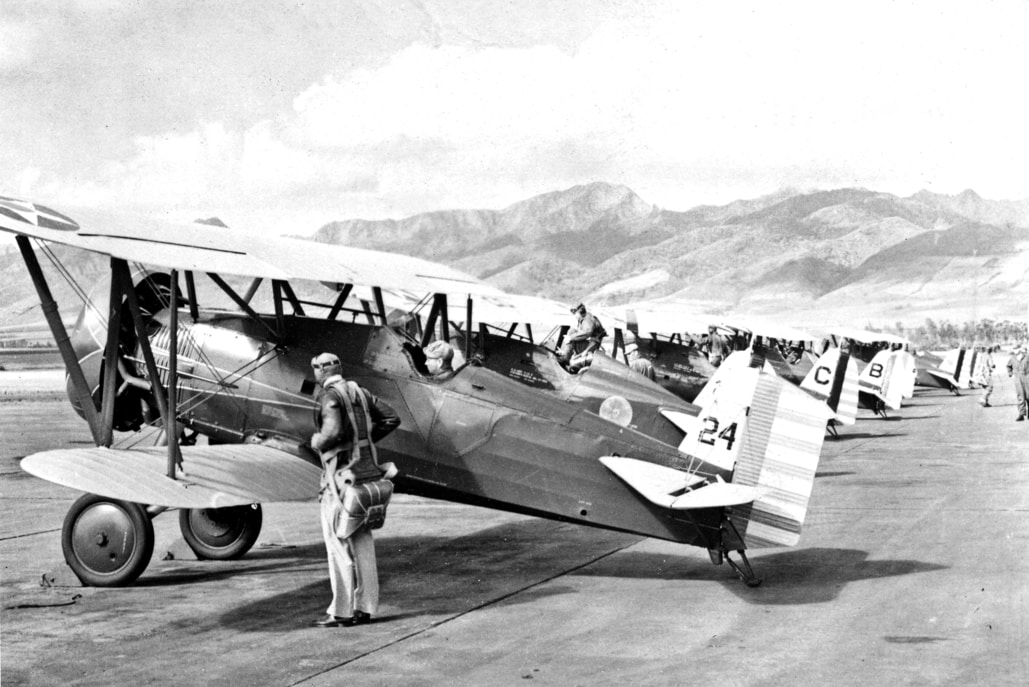
Several people have asked me for the full photo of the image that appears on the header for this site. Nice guy that I am, here it is: The 6th Pursuit Squadron at Wheeler Field, Hawaii, circa 1935. The 6th Pursuit (later Night Fighter) Squadron was inactivated in 1947, and despite being one of the older units (activated in 1917) it entered a long post-war slumber*. This was rectified in 2017, and once again the 6th is an active component of the USAF.
*Note: Wikipedia states that the 6th was reactivated in 1968, assigned to the 11th Air Force, and flew F-4 Phantoms for 25 years at “Alberts Air Base” in the “San Francesco Islands”. Not a word of this is even remotely true thus serving as a helpful reminder why Wikipedia is not an accepted source at any college or university.
Aloha from the 4th Observation Squadron
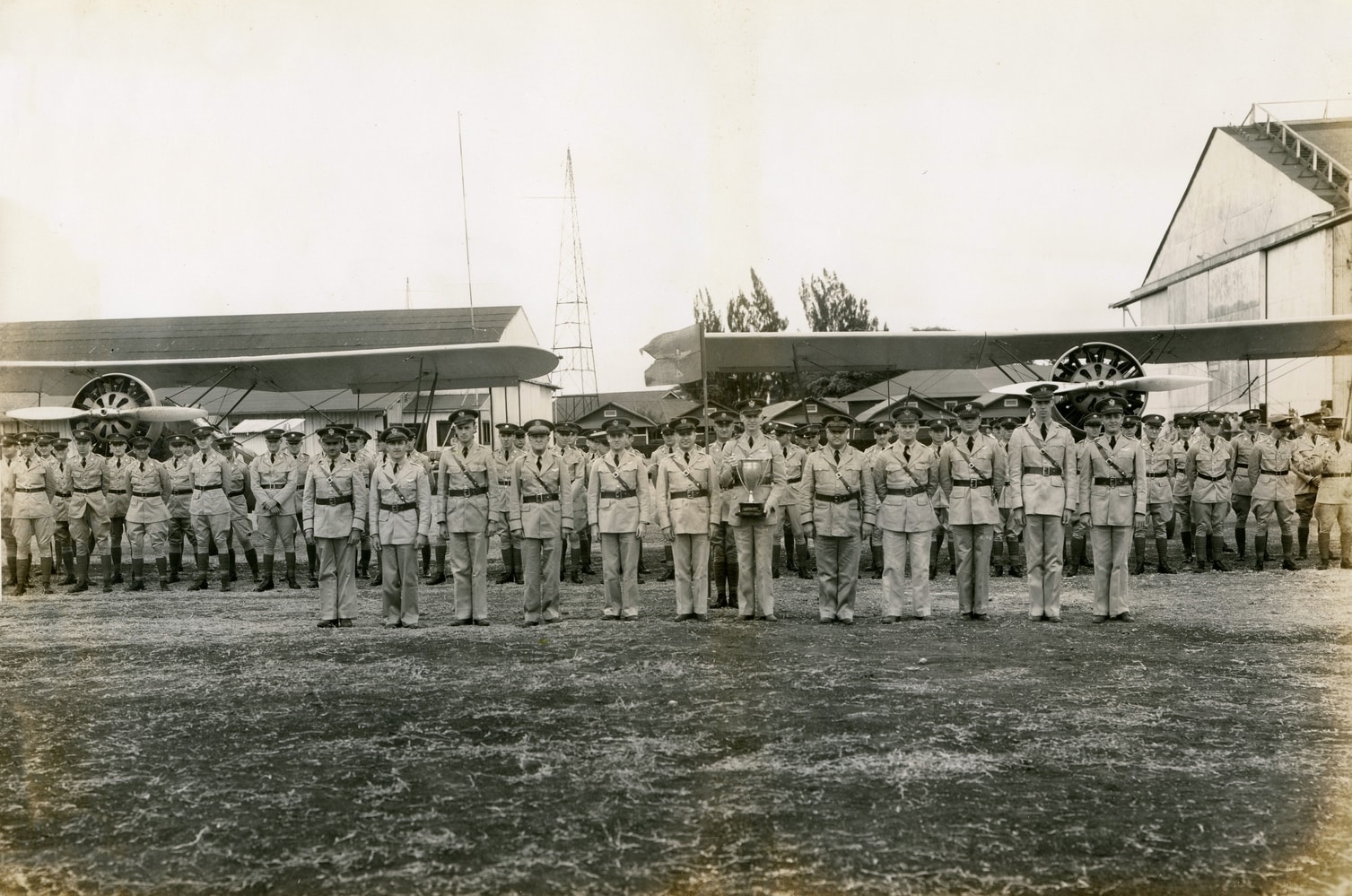
The location is Luke Field, Territory of Hawaii. The date, oh, sometime in the 1930s. The aircraft, the Thomas Morse O-19. The 4th had obviously just done something worthy of the sizable trophy held by the officer in the middle. Given the sedate performance of the O-19, it is safe to assume the trophy does not reflect the squadron’s establishment of a new world record for airspeed.
Y1B-7 pilots of the 31st Bomb Squadron

 The Jive Bomber