
Author: thejivebombers
The War Can Wait…
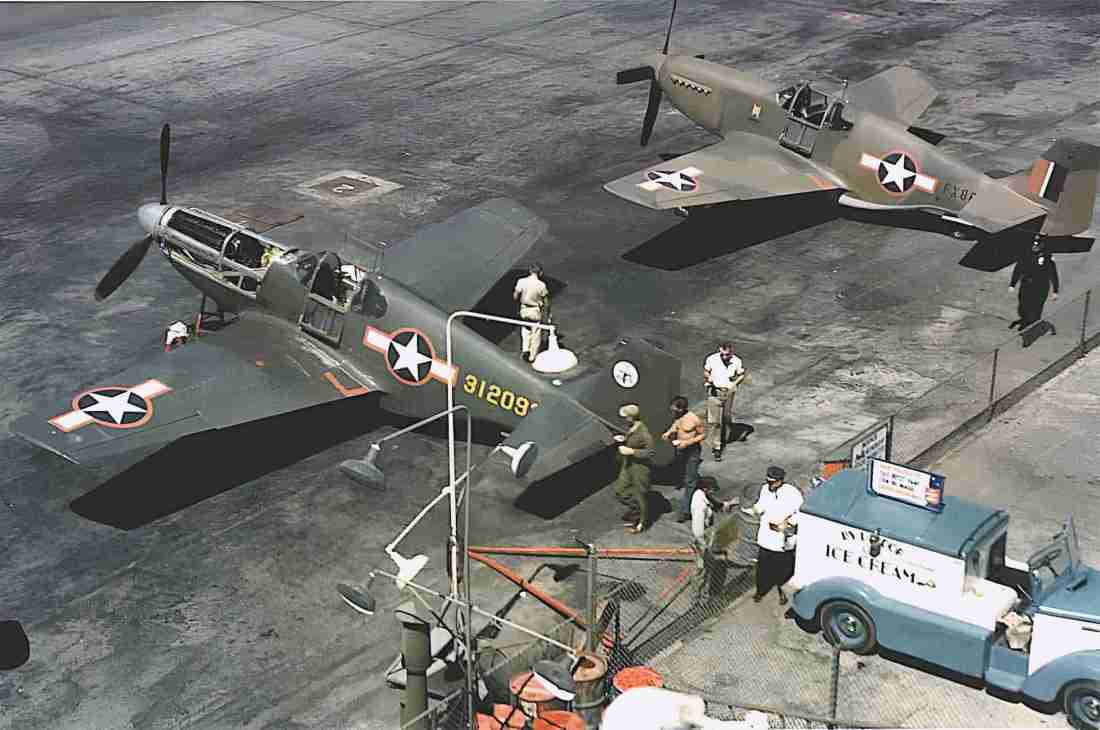
Los Angeles, Mines Field, 1943. When the ice cream man arrived, work came to a halt outside North American Aviation’s plant.
The pair of Mustangs are an interesting duo: the first P-51 “B” model (43-12093), and an RAF bird (FX863, also a “B” model). 43-12093, befitting its first-in-the-series status, was retained by NAA for test purposes. (Notice it is experimenting with a three-bladed propellor). Our Mustang III, FX863, never made it to the RAF but was instead handed over to the USAAF and eventually saw combat in the skies over Europe with the 357th Fighter Group.
Bats Outta Hell


A pair of B-25s from the 499th “Bat outta Hell” Bombardment Squadron.
Grasshoppers


“Ready Teddy” has an appropriate mascot clinging to the wing strut.

If anyone can identify the unit, or the location of these aircraft…


The gals are from the Red Cross.
The Piper L-4 – an airplane truly deserving of the term “classic”.
The B-52 A-Model

The first A model was also the first B-52 to feature a redesigned cockpit (side-by-side seating).

Serial numbered (appropriately enough) 52-001…

…the A model took flight in 1954.


A weight and balance sheet from one of 52-001’s test flights.

Last of the three A’s was 52-003 later used by NASA.

A few years earlier, 52-003 is seen screeching over a Seattle neighborhood in late 1954.

Looking out the right side…

…and the left. Mt. Rainier is seen thousands of feet below.

Inflight photo of 52-001.

This time it’s 52-002. There are one or two differences in the cockpit configuration between 001 and 002.

Judging by the clean slate, this has been a successful flight.
A grand total of three B-52A’s were built. Here, according to the accompanying citations, are all three of them.
The B-52D

As one can see emblazoned on its side, 55-049 was the first “D” model built at Boeing’s Wichita plant.

56-591 was used for a variety of tests including (unfortunately for its crew) the viability of the B-52 as a low-level bomber. On such a mission, the aircraft crashed 6/23/1959.

The next four photos are of one B-52D, 55-074.


56-0618 of Amarillo AFB’s 461st BW visits Yokota Air Base, Japan, in 1965. Photo courtesy of Max Pashnev.

55-0061 of the 96th Strategic Aerospace Wing in 1971. Aircraft was shot down over North Vietnam the following year. Photo courtesy of Max Pashnev.
One of Curtiss’s Countless Hawks

Over the years, Curtiss built the following:
Hawk, Hawk I, Hawk II, Turkeyhawk, Goshawk, Seahawk, Sparrowhawk, Goshawk (again), Hawk III, Hawk IV, Mohawk, Tomahawk, Kittyhawk, Warhawk, Seahawk (also again). Oh, and Curtiss also built a Hawk I for the Gulf Oil Company. It was named, you guessed it, the Gulfhawk.
The aircraft seen here is the P-3A (Hawk).
If “Hawk” could be tacked onto a word (or supplemented with Roman numerals) then Curtiss would immediately do so.
An Unfortunate Fortress
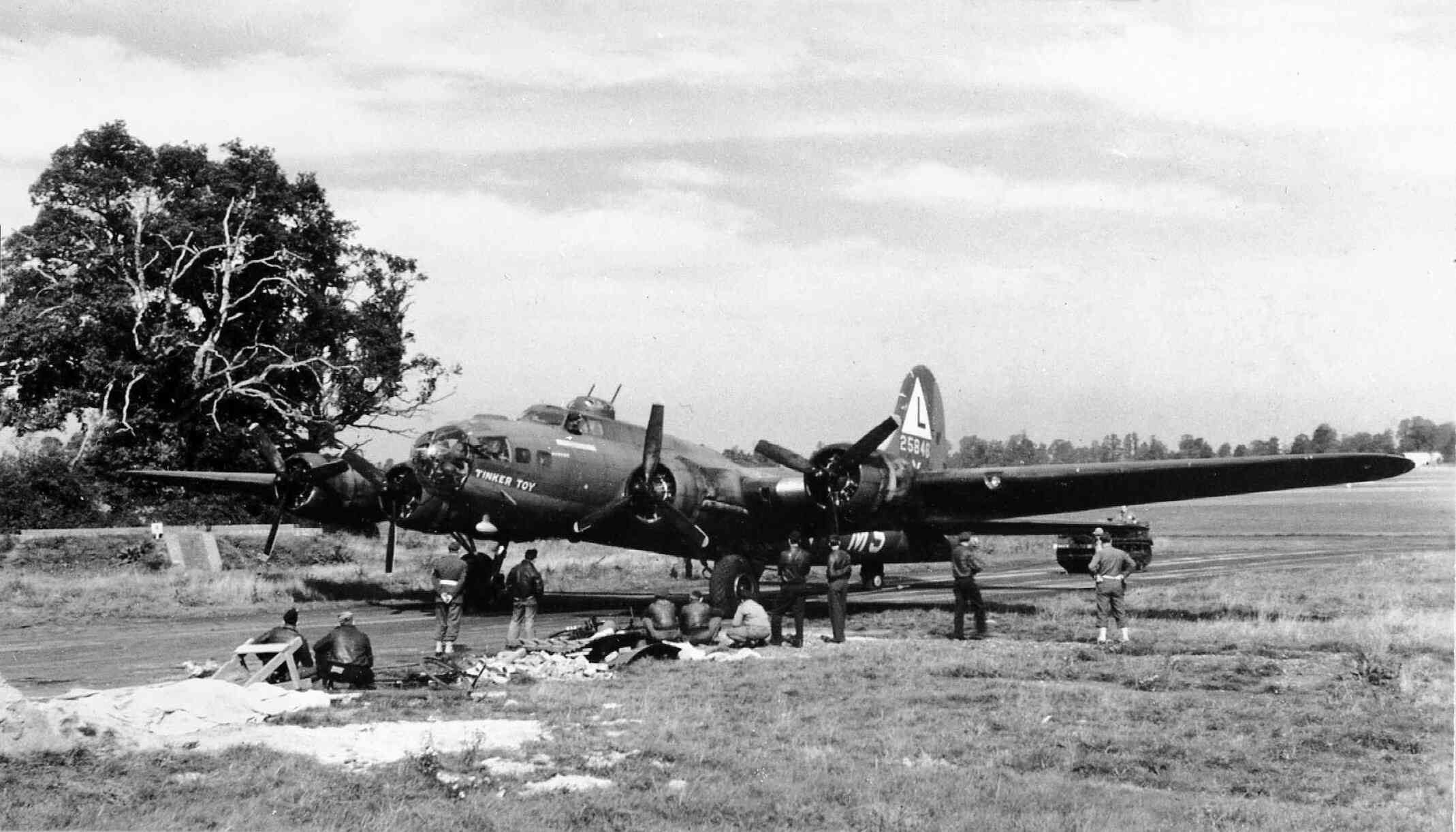
Some planes are unlucky; 42-5846 of the 535th Bomb Squadron, 381st Bomb Group at RAF Ridgewell was once such aircraft. In approximately six months of combat service, this B-17F, nicknamed “Tinker Toy“, had more than its fair share of sorrows. On one mission, the navigator was killed by flak. A later mission was even more harrowing when flak and fighters tore through the formation, resulting in the pilot killed and the copilot wounded. The flight engineer, after pulling the body of the pilot from his seat, flew the aircraft back to England, where he and the injured copilot made a successful landing.
On the 20th of December, 1943, Tinker Toy’s run of less than stellar fortune ran out: the plane was engaged by a BF-109 who, after raking the B-17 with gunfire, collided with its target, and both planes went down locked together. Seven men died in the Fortress, and the other three crewmen were taken prisoner.
Thus ended the saga of an unlucky B-17, but such tales were well-known to the bomber crews of the 8th Air Force during World War II.
The 707 Mini

Seen in the brief period it served as a test plane, N-93134 was the prototype 138 “B” model.

Photos are dated June 8, 1961.
It is easy to look at photos of a 707 and say to oneself, “Look, it is a 707”. However, any aficionado of Boeing’s first jet airliner knows there are more than a dozen 707 variants, and one of those derivatives was the 707-138B. Shorter by ten feet compared to the standard 707-120, the 138B was used exclusively by Qantas Empire Airways, which favored the abbreviated version due to its increased range.
The aircraft seen here, N-93134, is the first 138B built and was initially used for testing by Boeing. That project completed, in July of 1961, the bird was off to Australia as VH-EBH, “City of Darwin”.
One of the interesting details in these photos is that even though Boeing was using the plane for testing, it already bears most of the red and white livery of its ultimate customer: Qantas.
Randolph Field, 1930s

A BT-8 with its distinctive “hunchback” design.

PT-13 is ready for the next flying cadet.

This PT-13 is no doubt already well-aquainted with the budding birdmen of Randolph.

A BT-9 taxis along while airmen gaze at the distant A-12s and A-17s of the visiting 3rd Attack Group.

A-17s taxiing out. In the foreground is part of Randolph’s airfield lighting. Some of these lights are still at the base today.

A visiting C-33.


A Texas National Guard O-43.

A-17s of the 13th Attack Squadron.

More A-17s. These birds belong to the 90th Attack Squadron.

A-12 Shrike of the 13th Attack Squadron.

Another visitor: B-18 of the 32nd Bombardment Squadron.

No 1930s collection of Air Corps aircraft would be complete without a P-26 (or two). These are probably from the 20th Pursuit Group.

And of course, a visiting B-10 of the 30th Bombardment Squadron.
A small collection of photos from a flying cadet at Randolph Field in the mid-1930s.
It’s a Grumman Mallard


Already an exceptionally nice-looking plane, this Grumman G-73 was made even more handsome after Wien and their paint shop got through with it. Nicknamed the “Katmai Queen,” this Mallard (N1208) was caught on camera at Boeing Field sometime in the 1970s.
In photo #1, a DC-7 of the “Stardusters Air Travel Club” is visible.


Boeing 314 #1


It’s 1938, and Boeing’s new baby, the 314, makes its appearance in Seattle.

The first Model 314 sticks its tail over the Duwamish River. Note that the cockpit has yet to be completed.

Seen afloat on Seattle’s Elliot Bay, the first 314, now numbered NX18601, is ready to begin testing.

NX18601 was initially built with a single vertical stabilizer.


The single tail did not provide adequete directional control…

…and a fix was devised in the form of a double tail.

The short-lived double tail/no center stabilizer.

Even two tails were not doing the trick and thus the three-tailed 314 was born.

In the spotlight.
These photographs feature the first Model 314 produced by Boeing (later registered as NX18601). As with most prototypes, the first 314 model encountered some challenges during its development. One of the primary issues was related to lateral control. Although the aircraft was built with a standard single centerline vertical fin, early test flights revealed a need for more lateral control. To address this problem, a growing number of vertical stabilizers were installed on the aircraft. Initially, the solo center tail was removed and replaced with a pair of endplates. However, this dual arrangement proved insufficient, and a centerline fin was once again added to the aircraft, which proved to be effective in providing the necessary lateral stability. once again the 314 was provided with a centerline fin (Hey, good thing they didn’t throw that item away when they did the initial redesign of the tail)
Here’s a Pair of Oddball Amphibs…

Looking like some great beast took a bite out of its fuselage, the Great Lakes XSG-1 never went beyond this single prototype.

The Columbia XJL-1 was another also-ran in the world of US Navy seaplanes. This example (BuNo 31399) survives today at the Yanks Air Museum in California.
Goodyear’s Ducks


The first Duck – a GA-1.

Displaying one of its duck-like qualities, the GA-1 quietly floats on Lake Wingfoot, Ohio. Then and now, a hangar on said lake is home to the Goodyear Blimp.

A later version of the Duck: the GA-2. This aircraft, N5505M, was used by Goodyear for various purposes. Date of photo is June, 1960.
First flown in 1944, Goodyear’s GA Duck was a very handsome and well-performing aircraft, but (alas) it never went into major production. Of the less than two dozen GAs built (in various configurations), one, a four-seat “Drake”, survives today.
Update: Three months ago, a man in Kalamazoo, Michigan, wrote to me after reading this post on the GA Duck. In his email, he informed me that he had, since the death of his grandfather, come into possession of four Goodyear GA Ducks, all sitting in sheds and barns, and he was wondering if I had any ideas on what to do with them.
One often hears of old planes sitting in barns, but these are always tales too good to be true. Despite thinking this was one of those scenarios, I did, with some skepticism, ask for a few photos. Here is one of those pictures, and it pretty much says it all.

Still in their original paint, the Goodyear Ducks had been gathering dust for decades.
The man who bought the aircraft way back when never got around to restoring them for flight or display. They remained secreted away in two locations, unknown to the public until just a few months ago.
When the gentleman contacted me, hoping to find a home for these planes, he was talking to the right guy because, by chance, I just happen to be affiliated with an aircraft museum. Did we need such aircraft in our collection? Not really. Such aircraft as the Ducks are outside our museum’s focus. It was therefore decided to allow another museum to have a chance. That facility is the Military Aviation Preservation Society (MAPS) museum in Ohio, home to Goodyear, and where the GA Ducks were built. They are also home to what was previously the lone example of a Goodyear GA, the “Drake”. That bird will be in great company, a whole flock of Ducks.
PS. When I called MAPS to inform them of the find, they must of thought Christmas had arrived in March.
Sea Ranger on the Step

On a sunny day in Seattle, Boeing’s one and only XPBB-1 “Sea Ranger” races over the waters of Lake Washington as it heads for the skies.
It is worth noting that the orderly ripples on the otherwise smooth lake surface are likely manmade.
Story follows:
Per my late Dad (a WWII PBY pilot), ultra-smooth water can make for a problematic takeoff. Reason: the aircraft could have trouble breaking free from the water’s adhesive properties. Therefore, said Dad, a boat would be dispatched to speed about and ripple up the water on a smooth, non-windy day. Lacking a boat, the aircraft could engage in some downwind high-speed taxiing, then do a quick 180-degree turn and takeoff courtesy of the undulating ripplets now creasing the water.
The B-50 SuperDuperFortress

43rd Bomb Wing B-50s. In the background are RB-36s of the 28th Strategic Reconnaissance Wing.

RB-50F zooms skyward at Boeing Field. Note the fancy paint job on the external fuel tanks.

The one and only EB-50B. Used by Boeing for a number of schemes, notably, as seen here, testing “caterpillar track” landing gear.

The EB-50. One has to wonder what it felt like to operate with such landing gear.
Here are a few PVs of VPB-146…

PV crew during training at NAS Whidbey Island in the summer of 1943.

VPB-146 on Morotal in the Netherlands East Indies. This Ventura, 34874, was shot up during a Japanese air raid in ’44.

Veterans of many a mission, this VPB-146 crew poses by a PV sporting a “kill” marking for having sunk a Japanese ship.
Pair of P-51s


The first photo shows Bob standing on a wing. Bob (Chilton) has a great job: he is North American’s test pilot and, therefore, gets to fly brand-new Mustangs for his daily bread. The second photo shows one of the birds that may have been given the O-K back at the factory by Mr. Chilton himself (a P-51B, 42-106829 of the 362nd Fighter Squadron).
79th Air Rescue Squadron

An SH-19A Chickasaw displays its abilities before an appreciative B-36 of the 6th Bomb Wing while the latter is on a deployment to Andersen AFB, Guam. The bomber was far from its home at Walker AFB in New Mexico – about 7,000 miles – but that really wasn’t a very big deal for a B-36.
The Last Thing Seen by Many a Bug or Caterpillar

And…For the sake of the photographer’s health, one hopes he got all he needed with a single pass by the chemical-spewing Stearman. The good news for him is that by the time this picture was taken in the 1950s, the crop dusters were no longer using what had proven highly effective in the past: a liquid mixture of lead and arsenic. Seems like a bad idea now, but it didn’t at the time. We humans are like that – we only learn by experience (when does the city put up a stop sign at an unmarked intersection, before a bad car wreck, or after?).
The location is Washington state, the target, apple trees, and the critters and caterpillars that love them.
Corsairs & Seagulls


SOC alongside its mothership, USS Houston.

SOC aboard seaplane tender USS Currituck in 1947. The plane is being readied for dropping in the water.

Same aircraft seen in previous photo shows the rearseat man stowing the bridle used when hauling the aircraft in or out of the sea.

A pair of USS California SOCs as seen from the rear cockpit of another.

Another view of SOCs of the battleboat USS California.

SOCs and a variant, the SON-1 from Scouting 9 of the USS Honolulu.

O2Us aboard USS Chester. She and USS Indianapolis (R) are seen refueling from the tanker USS Salinas while enroute to South America in 1936.

USS Indianapolis arriving in Rio de Janeiro with a special passenger: President Roosevelt.

Chester and her O2Us depart Montevideo.

SOCs, USS Tuscaloosa.

Battleship USS New York is a sea of cranes and seaplanes.

USS Idaho. It took some guts to climb out on those guns.

Battleship USS Tennessee and her SOCs.

Here are two aircraft that had ridiculously long service lives by the standards of their time: Vought’s many variations of the O2U Corsair and the Curtiss SOC Seagull. In an era when an aircraft was here and gone in only a few years, the Corsair and Seagull served the US Navy for 19 and 14 years, respectively (and approximately).
O2U-2, VS-14M, CV-3, 1930


USMC Skyhawk
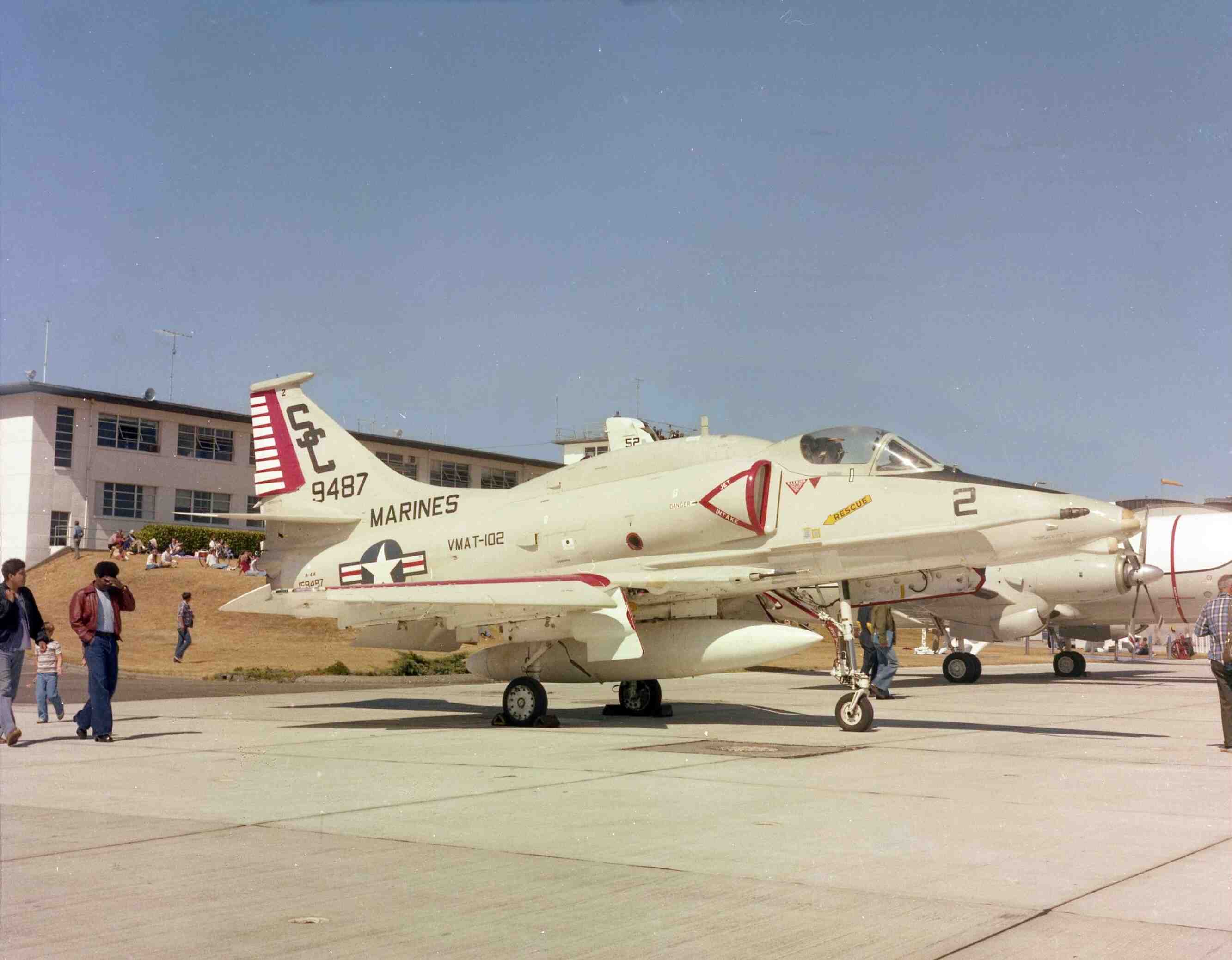
Based at MCAS Yuma, Arizona, this A-4M (159487) of VMAT-102 was no stranger to sunny days like the one seen here at NAS Whidbey Island in 1981.

