Hurrying across the hills of Southern California, 18 SBC Helldivers of Scouting Squadron Three (VS-3) make a fine display for the cameraman.The men of VS-3 aboard their home base, USS Saratoga. The ship’s main battery of 8″ guns makes a nice backdrop. Note the small saluting/practice gun at the base of the big rifle barrels.
Many have dismissed this armament on America’s early carriers Lexington and Saratoga as a throwback, a sop to the old-school admirals who could not fathom that the day of the big gun ship had been eclipsed by aircraft. Believing that fossilized admirals were wedded to outdated beliefs sounds dramatic. Still, that belief ignores a simple fact: The battle aircraft of that period were pretty well limited to fair weather operations and, thus, were not a reliable substitute for a capital warship’s heavy armament. Therefore, big guns were needed, but not as offensive weapons (the relatively unarmored Lexington and Saratoga were not to fill part of the battle line). What was required were defensive weapons. What type and size of defensive guns? The Lex and Sara were speedy vessels and could easily outrun any battleship of that time, so battleship-sized guns were not required. What they could not outrun was a cruiser. Given that the typical armament for a cruiser was 8″ guns, it made sense to provide the same weaponry to the two carriers.
Less than ten years after the two carriers were commissioned, the advances in aviation technology made the big guns less critical, and they were eventually removed. While those guns were in service, they were not there at the insistence of outmoded and narrow-minded navy brass. When the two carriers were designed, the question must have been asked: what were they to do on a zero-visibility day with aircraft grounded and an enemy cruiser sweeping through the mist? Answer: Provide the two ships with all-weather firepower. It was a perfectly sound idea.

 Hurrying across the hills of Southern California, 18 SBC Helldivers of Scouting Squadron Three (VS-3) make a fine display for the cameraman.
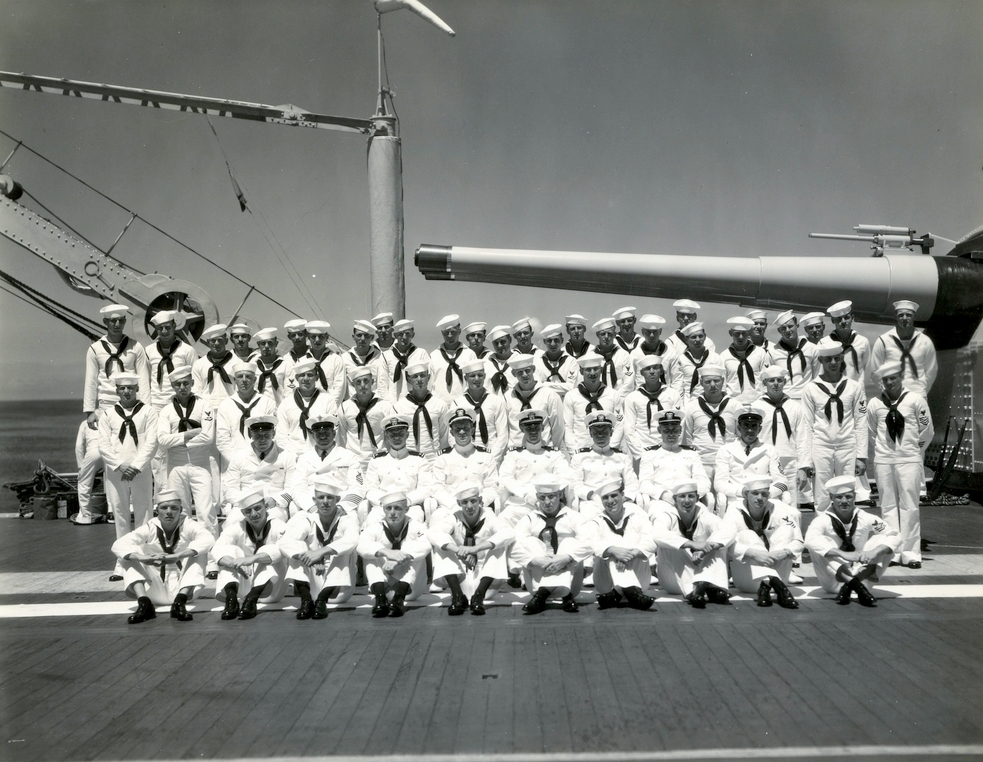 The men of VS-3 aboard their home base, USS Saratoga. The ship’s main battery of 8″ guns makes a nice backdrop. Note the small saluting/practice gun at the base of the big rifle barrels.
 The Jive Bomber